

Fiscal Year 2026 Sustainability Report
Cautionary Language
Unless the context requires otherwise, we are referring to Guidewire Software, Inc. together with its subsidiaries when we use the terms “Guidewire,” the “Company,” “we,” “our,” or “us.” When using the term “products,” we are generally referring to both our subscription services and term license software.
Cautionary Language Concerning Forward-Looking Statements
The statements, estimates, projections, guidance, and/or outlook contained in our Fiscal Year 2026 Guidewire Corporate Sustainability website (this “website”) include “forward-looking statements” within the meaning of the “safe harbor” provisions of the Private Securities Litigation Reform Act of 1995. These forward-looking statements are made as of the date they were first published and were based on then-current expectations, estimates, forecasts, and projections as well as the beliefs and assumptions of management. Words such as “expect,” “anticipate,” “should,” “believe,” “hope,” “want,” “strive,” “aim,” “target,” “commitment,” “project,” “goals,” “estimate,” “plan,” “potential,” “predict,” “continue,” “contemplate,” “possible,” “may,” “will,” “might,” “could,” “would,” “intend,” “seek,” and variations of these terms or the negative of these terms and similar expressions are intended to identify these forward-looking statements. Forward-looking statements are subject to a number of risks and uncertainties, many of which involve factors or circumstances that are beyond our control, including, but not limited to, risks detailed in our most recent reports on Forms 10-K and 10-Q filed with the U.S. Securities and Exchange Commission (“SEC”), as well as other documents that may be filed by us from time to time with the SEC. In particular, the following factors, among others, could cause results to differ materially from those expressed or implied by such forward-looking statements: the risk of retaining existing and hiring new personnel, maintaining our company culture, and managing a hybrid and geographically distributed workforce; the challenges of international operations and growing our business; exposure to market risks, including geographical and global events, supply chain disruptions, inflation, and political and regional conflicts; competitive pressures; issues in the development, adoption, deployment, workforce use, and maintenance of artificial intelligence technologies, including machine learning, generative and agentic AI, and automated decision-making technologies (collectively, “AI”); failures, security vulnerabilities, or service interruptions of third-party technologies and service providers we utilize; unexpected delays, difficulties, and expenses in executing against our environmental, climate, inclusion, or other sustainability targets, goals, and commitments outlined on our website; internal controls and processes that continue to evolve; increased scrutiny and varying stakeholder expectations with respect to sustainability matters; methodologies for measuring data that are complex, subject to various interpretations, and continuing to evolve; cybersecurity effectiveness; and changes in laws, enforcement, investor sentiment or demands, or litigation relating to or otherwise affecting our sustainability commitments; and other risks and uncertainties. Past performance is not necessarily indicative of future results.
The information and opinions contained on this website are based on information available to us as of the date it was posted, and are subject to change without notice. We do not undertake, and expressly disclaim, any obligation to update or revise any such information or statements. Our commitments, targets, aims, and goals may change over time for many reasons, such as the evolving nature and availability of standards, changes to our business as well as changes in business priorities, shifting stakeholder significance, new industry practices, technology or science, or changes to law or regulatory guidance. Moreover, while we reference various third-party standards in making our disclosures, we cannot guarantee (and any language of “alignment” or similar should not be taken to mean) complete adherence to such standards or any particular stakeholder’s interpretation thereof.
While information presented on this website has been subject to internal review processes and controls, much of this information is subject to assumptions, estimates, third-party information, or methodologies that are still evolving and subject to change. Similarly, various aspects of this website are based on policies and procedures that we believe apply appropriate levels of support to address issues in scope. While these statements may use words such as “ensure,” “prevent,” or similar language, such terms should not be considered to mean (as there can be no guarantee) that such efforts will be successful in all situations.
Materiality Disclaimer
This website contains statements based on hypothetical scenarios and assumptions as well as estimates that are subject to a high level of uncertainty. These statements should not necessarily be viewed as being representative of current or actual risk or performance, or forecasts of expected risk or performance. In addition, historical, current, and forward-looking environmental and social-related statements may be based on standards for measuring progress that are still developing and on internal controls and processes that continue to evolve. While certain matters discussed on this website may be significant, any significance should not be taken, or otherwise assumed, as necessarily rising to the level of materiality used for purposes of complying with our public company reporting obligations pursuant to the U.S. federal securities laws and regulations or other reporting obligations, even if we use the words “material” or “materiality” in this report.
No Incorporation by Reference
This website, which constitutes our Fiscal Year 2026 Guidewire Corporate Sustainability Report, includes references and links to other company reports, public filings, and resources. These references are provided for convenience only and the referenced documents should be read in their entirety. They are not incorporated by reference into this website.
Furthermore, this website is not intended to be incorporated by reference into any of our filings with the SEC, unless specifically stated otherwise.
Sustainability Approach
About Our Reporting
Our sustainability reporting on this website generally covers social and governance performance metrics and narrative disclosures for the fiscal year ended July 31, 2026, and environmental performance metrics and narrative disclosures for the fiscal year ended July 31, 20251, unless otherwise noted. Social, governance, and environmental performance metrics and narrative disclosures may extend beyond these periods where relevant to our sustainability strategy and ongoing initiatives. We anticipate updating the website as additional relevant information becomes available, providing information in real time, as opposed to one annual update. This website reflects our global performance, including our wholly owned subsidiaries. Any variances from this approach are noted directly on this website.
Reporting Guidelines
We anticipate updating information on this website as it becomes available and have developed such information in the context of: (1) the Global Reporting Initiative (“GRI”) Universal Standards, which focus on key risks significant to us and our stakeholders; (2) the Task Force on Climate-related Financial Disclosures (“TCFD”) recommendations2; and (3) Sustainability Accounting Standards Board (“SASB”) Standards, now part of International Financial Reporting Standards (“IFRS”) Standards, Software and IT Services Sustainability Accounting Standard, Version 2023-12. Please see the GRI, TCFD, and SASB indices in the Appendix on this website for cross-references and a map of applicable performance metrics and narrative disclosures from this website to each framework.
As standards, frameworks, and regulations evolve, we will seek to align our sustainability reporting with regulations and best industry practices.
To the extent this Corporate Sustainability website is updated prior to the filing of that year’s proxy statement, we will update references in the GRI, SASB, and TCFD indices in the Appendix once the applicable proxy statement is filed with the SEC, generally around late October.
We retained a third-party external assurance provider, Apex Companies (“Apex”), to provide limited assurance of our fiscal year 2023-2025 Scope 1, 2, and 33 greenhouse gas (“GHG”) emissions included on this website4. The environmental, governance, people, and corporate citizenship data presented in the data tables, indices, and narrative disclosures on this website have been subject to our internal review processes and controls, but has not been audited or verified by an independent third party.
- We expect to disclose our fiscal year 2026 Scope 1, 2, and 3 greenhouse gas (“GHG”) emissions with limited assurance thereon as an update to our Corporate Sustainability website in or around June 2027. ↩
- We plan to transition to reporting against IFRS S2 Climate-related Disclosures in fiscal year 2027 in place of the TCFD recommendations. ↩
- Scope 3 GHG emissions for fiscal years 2020, 2024, and 2025 include the following categories: purchased goods and services, capital goods, fuel and energy related activities (“FERA”), business travel, employee commuting, waste, and investments. GHG emissions for fiscal years 2021 and 2022 were also provided limited assurance from Apex, but are not included in the Environmental Sustainability Data Tables. Emissions categories excluded from limited assurance are noted in our Environmental Sustainability Data Table footnotes and in the External Assurance disclosures in the GRI Index. ↩
- Additional information about Sustainability at Guidewire can be found in our 2025 CDP Corporate Questionnaire. This annual CDP Corporate Questionnaire is usually released in or around February and will be linked to the Appendix of this website in or around June of the following year. ↩
Guidewire at a Glance
Founded in 2001, Guidewire is a publicly traded company (NYSE: GWRE) that delivers a platform that property and casualty (“P&C”) insurers trust to engage with customers, innovate, and operate more efficiently. We serve insurers of all sizes, ranging from global carriers to regional and local providers, helping them navigate a rapidly changing insurance market.
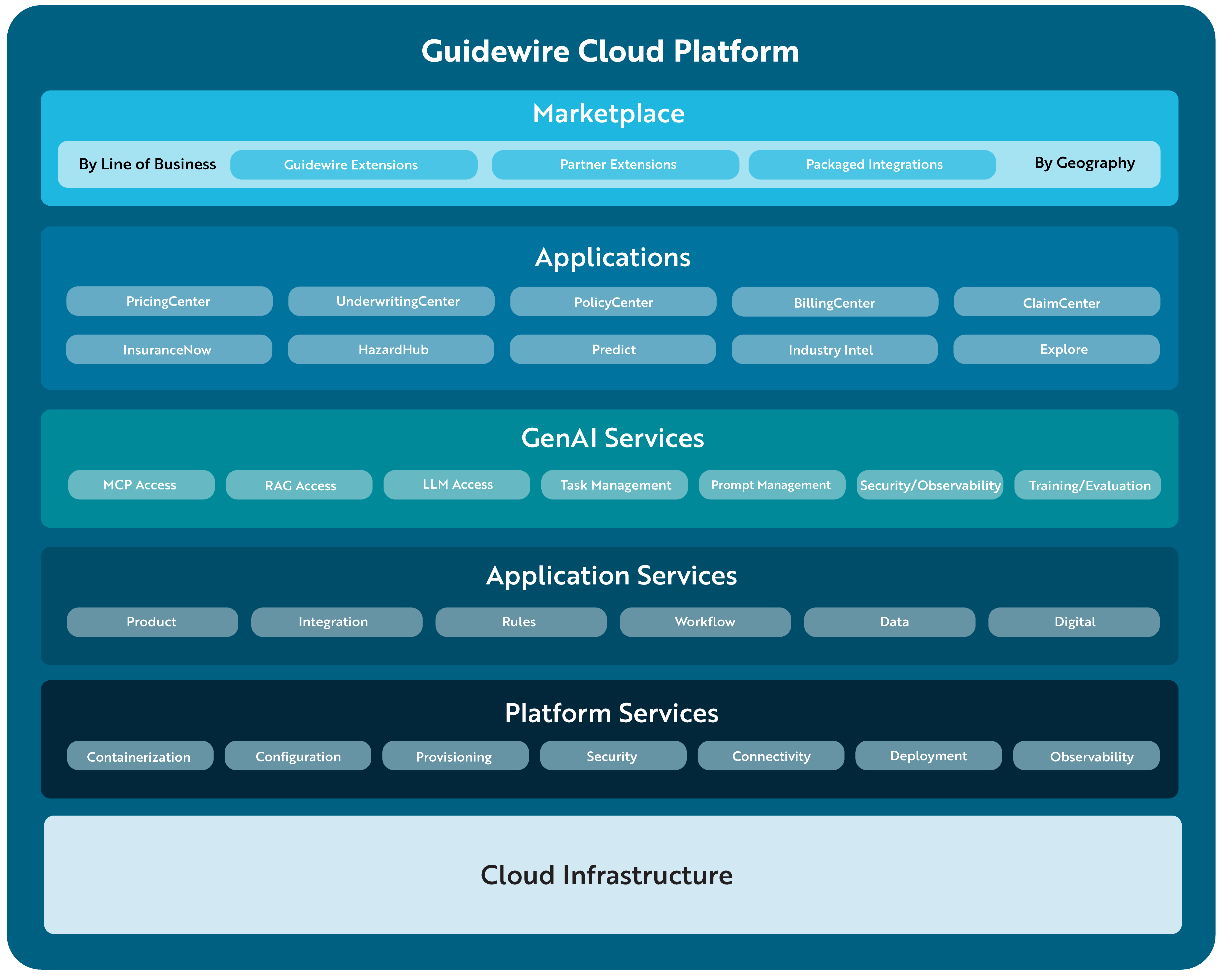
Our foundational core products, InsuranceSuite and InsuranceNow, are delivered as a cloud-based subscription service leveraging our proprietary cloud platform which we refer to as Guidewire Cloud Platform (“GWCP”). These products serve as transactional systems of record, fully supporting insurance operations, including product definition, pricing and rating, underwriting, policy administration, billing, and claims management. Our platform combines core systems of record with digital, analytics, and predictive and generative artificial intelligence capabilities. Our platform provides enhanced claims experiences for policyholders, agents, vendors, and field personnel, and analytics products that allow insurers to manage and use data more effectively, gain business insights, improve operational efficiency, and underwrite emerging risks.
Since our initial public offering in January 2012, we have increased the scope of our platform, products, and business through internal development and acquisitions. This growing scope has required greater investment in the development of Application Programming Interfaces (“API”), integrations, and other shared services necessary to unify the operations and user experience across our application portfolio. The prioritization of cloud-delivered solutions has also required significant focus in improving our ability to manage, secure, and operate our applications on behalf of our customers, consistent with a cloud-based service.
We continue to invest in research and development efforts, focusing on new and enhanced products, embedding AI services across our platform to enable agentic development and deliver AI assistants to guide users and automate tasks across the P&C insurance lifecycle, and enhancing our platform services with operational efficiency, data analytics, security, and privacy in the cloud. We also invest significantly in developing our products and necessary integrations to meet the market requirements, including regulations, languages, currency, and local terminology, of each country or state in which our customers operate.
Our investments in cloud operations are focused on managing the infrastructure for our cloud-based customers in a secure, efficient, and cost-effective manner.
Products and Technology
- Our core products include Guidewire InsuranceSuite, which comprises five core applications (PolicyCenter, ClaimCenter, BillingCenter, PricingCenter, and UnderwritingCenter) and Guidewire InsuranceNow
- Our complementary capabilities and applications, some of which are included in our core operational services and products, and all of which are designed to work seamlessly with our core operational services and products, including Guidewire Rating Management, Guidewire Reinsurance Management, Guidewire Client Data Management, Guidewire Advanced Product Designer, Guidewire Product Content Management, and Guidewire ProNavigator
- Our digital engagement applications enable insurers to provide digital experiences to customers, agents, vendors, and field personnel through their device of choice. Digital engagement applications are enabled by the Jutro Digital Platform
- Our data and analytics applications allow insurers to evaluate risks and write more profitable business by enabling a seamless path from data to value
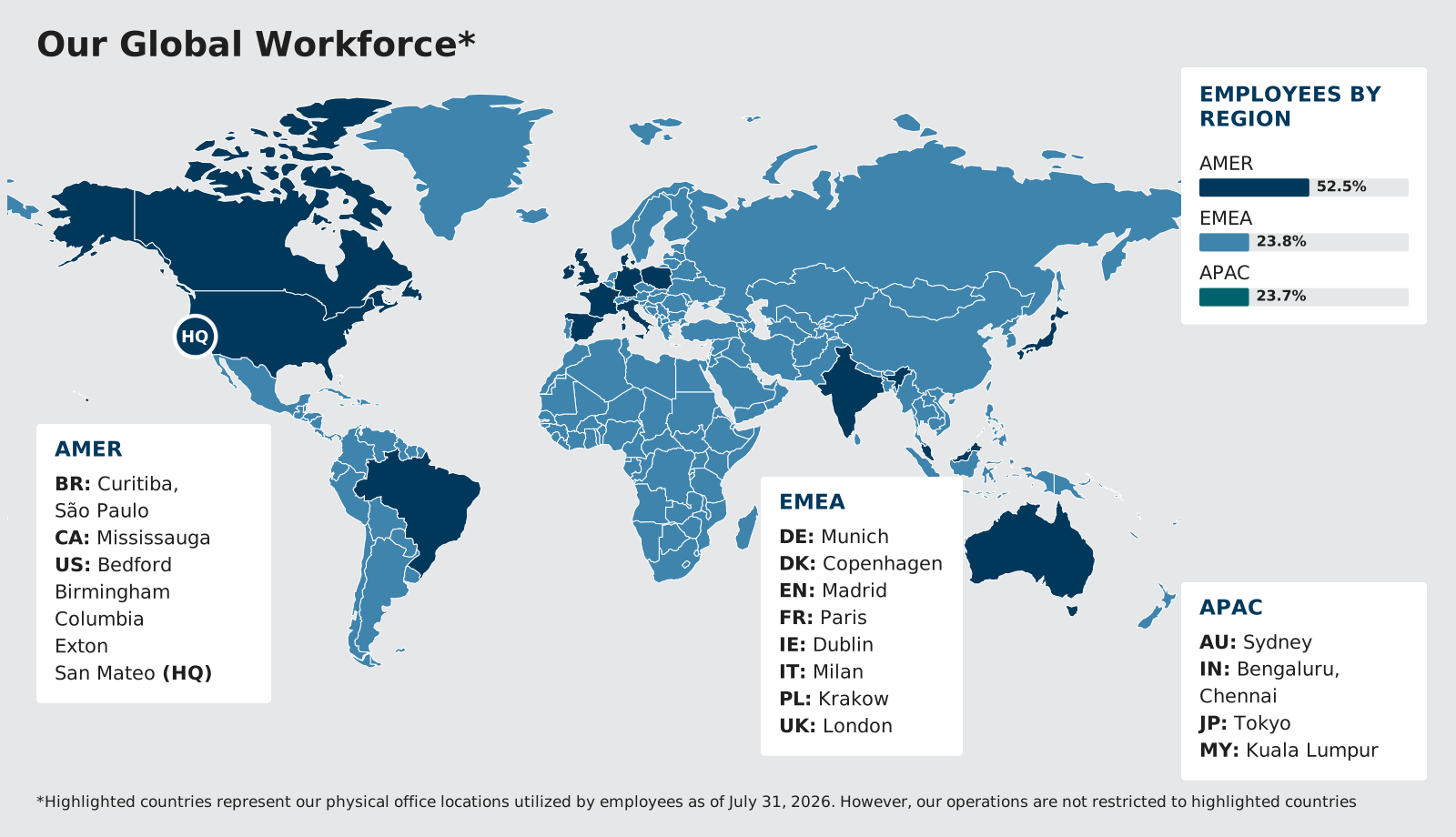
In fiscal year 2026, our annual revenue was $1.5 billion, 23.1% of which was invested in research and development, and our global headcount was 4,174. We attribute our success to, among other things, our core principles of integrity, rationality, and collegiality as well as our growth strategy, which includes expanding our international operations, increasing market acceptance of our cloud-based solutions including expanding adoption among existing and new customers, and aligning with or strategically acquiring shares or assets of companies with software, cloud-based services, technologies, or businesses that are complementary to ours.
Awards and Recognitions
We are proud to highlight some workplace and industry awards we have received in recent years:
Workplace
Built In
- Best Places to Work Boston, MA (All Sizes Category, 2025)
- Best Places to Work Boston, MA (Large Category, 2025)
- Best Places to Work San Francisco, CA (Large Category, 2025)
Comparably Awards
- Best Company Outlook (Large Category, Global; 2026)
- Best Company for Women (Large Category, Global; 2026)
- Best Company Culture (Large Category, Global; 2025)
- Best Company Compensation (Large Category, Global; 2025)
- Best Company Happiness (Large Category, Global; 2025)
Top Employer India
- Top Employer India (2025, 2026)
Great Place to Work® Ireland
- #11 Best Workplaces (Large Category, 2026)
- Best Workplace in Tech (2025)
U.S. News and World Report
- Best Companies to Work For (2025)
Industry
InsuranceSuite
- Named a ‘Leader’ in the Gartner Magic Quadrant for SaaS P&C Insurance Core Platforms, North America (2025)
InsuranceNow
- Named a ‘Challenger’ in the Gartner 2025 Magic Quadrant for SaaS P&C Insurance Core Platforms, North America (2025)
Claims
- Guidewire ClaimCenter named a ‘Leader’ in Everest Group’s AI-enabled Claims Management Systems for Property & Casualty (P&C) Insurance - Products PEAK Matrix Assessment (2025)
Analytics
- Guidewire Predict named ‘Embedded Analytics Solution of the Year’ in Data Breakthrough Awards (2025)
Cloud
- Won Best Cloud Migration or Sysems Integration Solution from the Cloud Awards (2024-2025)
Policy
- Won three XCelent awards and named a Luminary in North America in Policy Administration Systems: P&C Insurance, North America (2025)
- Won Six XCelent Awards and ‘Luminary’ Distinction in Celent’s Regional Reviews of P&C Policy Administration Systems - EMEA (2025)
IDC Financial Insights FinTech Rankings
- #22 out of 150 companies in the IDC FinTech Rankings - the only P&C insurance industry platform provider ranked in the top 25 (2025)
Sustainability Governance
While our entire Board of Directors (“Board”) engages on sustainability matters that impact our business, it has assigned primary responsibilities to specific committees of the Board to oversee sustainability risks and strategies in areas such as the environment, data security, human capital management and inclusion, corporate citizenship, and risk management.
- The Nominating and Corporate Governance Committee (the “NCG Committee”) exercises primary oversight of our sustainability efforts, including monitoring our approach, reviewing our corporate citizenship and sustainability initiatives and targets, and reviewing with our management the impact of our business operations and practices. The NCG Committee periodically reports to our Board with regard to our sustainability programs, including potential long- and short-term trends and the impact of sustainability issues on our business.
- The Audit Committee reviews with our management the type and presentation of our key sustainability and climate disclosures and the adequacy and effectiveness of applicable internal controls related to such disclosures. Additionally, the Audit Committee reviews the Company’s alignment with relevant reporting standards, the use of external assurance, and how sustainability and climate risks are incorporated into our overall risk management processes.
- The Compensation Committee is tasked with considering our sustainability efforts when evaluating executive compensation, evaluating the impact of sustainability matters on executive officer and employee performance, and reviewing and discussing with management our compensation initiatives, policies and disclosures with respect to sustainability matters. In addition, it reviews with management our human capital management activities.
- The Risk Committee reviews and assists with oversight of our key risk exposures, including operational risks related to business continuity, information security (“security”), data management and privacy, and our use of emerging technologies, including AI, to the extent such use presents material operational, ethical, or compliance risks.
We advanced our sustainability strategy in fiscal year 2026 by building on the results of our second materiality assessment, conducted in fiscal year 2023. We also identified sustainability goals through half yearly meetings with our management level Sustainability Task Force (“Sustainability Task Force”) and quarterly meetings with the NCG Committee, made progress on our Science Based Target initiative (“SBTi”) validated climate goals, and completed a quantitative scenario analysis to validate the financial impact of climate risks and opportunities.
Management-Level Sustainability Oversight
Our Chief Executive Officer and Executive Management Team (“M-team”) are responsible for our overall sustainability strategy and performance, as well as the appropriate policies and processes used to manage sustainability across our business.
Our Head of Sustainability is responsible for leading our integrated strategy and engaging with cross-functional teams and business leaders to align and manage our sustainability initiatives. Additionally, our management-level Sustainability Task Force is a cross-functional group responsible for our overall sustainability program’s strategic performance, including the creation and support of appropriate policies, processes, and activities to manage sustainability matters across the business. Our Sustainability Task Force meets at least half-yearly and advises on sustainability disclosures and key initiatives.
Our Goals
We conduct periodic materiality assessments with the aim of developing sustainability reporting and processes consistent with internal and external stakeholder expectations, understanding our most important sustainability topics, and anticipating and managing future risks and opportunities.
Our Sustainability Strategy
As part of our fiscal year 2023 materiality assessment, we validated the three pillars established in our initial 2020 assessment and added programs under each pillar. Additionally, we continued to evolve our product sustainability strategy, which spans all three pillars and connects to programs in each pillar.
We also developed a three-year plan with an external consultant that is enabling us to mature our sustainability program, particularly in the topic areas that our internal and external stakeholders prioritized during our materiality assessment process. Our three-year roadmap includes topic-aligned actions that are designed to support Guidewire’s competitiveness and long-term business prospects.
Pillars and Programs
- Governance and Ethics
- Security and Data Privacy
- Responsible Sourcing and Procurement
- Inclusion and Belonging (“Inclusion”)
- Guidewire Gives Back (“GGB”)
- Employee Health, Safety, and Wellness
- Human and Employee Rights
- Emissions and Energy
A detailed description of our fiscal year 2023 materiality assessment and matrix can be found here.
Stakeholder Engagement
We engage both internal and external stakeholders in a variety of ways and seek to establish a two-way dialogue that informs our programs, products, processes, and policies. We define Guidewire’s stakeholders as those groups that can influence and be influenced by our business products and by our presence.
Our Approach
- Investors (stockholders and institutional investors)
We engage with investors on a broad range of topics, including trust and integrity, talent management, and emissions and energy through our public disclosures. We also communicate more directly through earnings calls, one-on-one conversations with portfolio managers and investment stewardship teams, and the annual stockholder meeting. Additionally, we maintain a robust stockholder outreach program, regularly engaging with our largest institutional stockholders and key investors to discuss executive compensation, corporate governance, sustainability, and other priorities, and to gather feedback to better understand their perspectives1.
- Customers (P&C insurers)
We engage with customers on various material topic areas, including product sustainability, emissions and energy, inclusion, security and data privacy, human rights, governance and ethics, and Guidewire Gives Back (“GGB”) initiatives and programs. We engage through direct conversations and responses to requests for proposals, along with providing information to sustainability rating agencies such as EcoVadis and CDP. We also engage through conferences, customer roundtables, and executive forums, and Business Advisory Councils for our customers.
- Employees
Our business requires attracting, developing, and retaining a motivated team of individuals who thrive in a culture based on integrity, rationality, and collegiality. We engage with our employees through our Employee Resource Groups (“ERGs”), manager one-on-ones, Slack channels, our employee intranet, annual employee pulse surveys, department and company meetings, individual and team performance-management and goal-tracking system, and our “VPMOM” (Vision, Principles, Methods, Obstacles, Measures) initiative, an internal management-by-objective goal setting process.
- Communities and Nonprofits
We engage with communities and nonprofits through our product sustainability, inclusion, emissions and energy, and GGB initiatives and programs. The latter includes corporate strategic giving, GGB matching gifts, product donations, skilled volunteer opportunities, volunteer time off, and signature initiatives. We also connect through in-person meetings, conference calls, and events. We also strategically partner with nonprofit industry associations and think tanks, such as the World Economic Forum, on the topics of security and data privacy and building climate resilience.
- Government Entities
We engage with government and regulatory bodies in the countries in which we operate through industry associations and public policy forums. Topics we engage on include security and data privacy and product sustainability. We are committed to compliance with all applicable laws and regulations, and, where possible, aim to implement policies and processes ahead of changing legislation. We are not currently a politically active organization, and we do not contribute to political campaigns or participate in direct lobbying efforts.
- Suppliers, Vendors, and Business Partners
We engage with suppliers, vendors, and business partners on our business strategy and topic areas such as governance and ethics, climate and energy, as well as labor and human rights through requests for proposals, our supplier sustainability survey, our vendor management portal, in-person meetings, calls, and conferences.
- We report in our Proxy Statement on our stockholder engagement efforts, including the number and aggregate holdings of institutional stockholders and key investors we reach out to, the topics discussed, and the feedback received. We also highlight actions taken or under consideration by our Board and committees in response to stockholder input. We generally file our annual Proxy Statement with the SEC in late October. ↩
Governance
Governance and Ethics
We embed trust and integrity into our culture by building and evolving strong corporate governance and compliance frameworks that support transparency, risk management, ethical conduct, and accountability.
Ethics and Compliance
We operate under a number of governance policies, including our Code of Business Conduct and Ethics (the “Code”). The Code applies to all of our directors, officers, and employees, including our chief executive officer, principal financial officer, principal accounting officer, and all other executive officers. We require all full-time employees, including our officers, to sign the Code upon hire. In fiscal year 2022, we adopted a Supplier Code of Conduct, most recently revised in March 2025, that extends our standards to our value chain. Further, the Board periodically reviews our Corporate Governance Guidelines, which were most recently revised in December 2025, in relation to the oversight of our business in accordance with its fiduciary responsibilities. In March 2023, we amended our Insider Trading Policy in keeping with best practices and in a manner consistent with then recent amendments to applicable federal securities regulations.
To help employees understand the expectations in our governance policies, we require all of our employees, including our officers, to complete mandatory ethics, security, and compliance training. We also reinforce accountability by requiring all field-facing personnel to complete anti-bribery and anti-corruption training every two years. Furthermore, we have a Disclosure Committee review process that queries designated employees quarterly on financial propriety and other ethical matters or concerns relevant to our public disclosures. To build on our existing training and disclosure initiatives and further strengthen our risk-management culture, we periodically remind our employees of the various ethics programs available to them. Additionally, we regularly provide our Board with information on director education programs, covering topics including, but not limited to, ethics and privacy. We encourage attendance and cover the costs for directors to attend these external programs.
Responsible AI
Guided by our core value of integrity, we are committed to the responsible, secure, and transparent development and use of artificial intelligence (“AI”) across our product offerings and operations. Our full Board oversees our overall AI strategy. The Board provides oversight of our AI risk management strategy and governance framework and receives regular updates from management regarding the deployment of emerging technologies and efforts to identify and mitigate associated operational, ethical, security, and compliance risks. At the management level, AI initiatives are governed by a cross-functional leadership team representing product development, engineering, legal, privacy, and risk management. This group is responsible for implementing operational guardrails and internal policies, maintaining robust data security standards, and ensuring AI technologies undergo rigorous internal vetting to support the high standards of safety and reliability expected by our customers and the P&C insurance industry.
Facilitating Whistleblower Reports
We consider communication and remediation to be critical elements of our compliance framework. To support these efforts, we maintain, through an independent third-party vendor, an online submission form for employees and non-employees to submit complaints regarding accounting, internal accounting controls, or auditing matters they believe to be questionable. Employees and non-employees may also submit any such complaints via U.S. mail directly to the Chair of the Audit Committee or through a 24/7 telephone hotline. We have established an additional ethics reporting system consisting of a monitored email address for employees and suppliers to report suspected illegal or unethical non-financial concerns confidentially. Our Audit Committee has oversight over both the whistleblower hotline and the ethics reporting system.
Respecting Human Rights and the Environment
In fiscal year 2023, we aligned the inclusion commitment in our Human Rights Statement with the Code of Business Conduct and Ethics. Our Sustainability team reviews our Human Rights and Environmental Policy Statements annually, and updates on the Human Rights Statement are periodically provided to the NCG Committee, which exercises primary oversight of sustainability policies and practices. We have also taken steps since fiscal year 2020 to align with the UK Modern Slavery Act 2015.
Security and Data Privacy
As a company that delivers its products as a cloud service, we take a comprehensive approach to the governance of security and data privacy. We maintain a security- and privacy-first mindset as we grow and invest in the products, infrastructure, personnel, best practices, and policies required to secure and protect the data entrusted to us.
Ensuring Security
We are committed to continuously updating our security program to meet ongoing and evolving threats and security challenges. Our management approach is to analyze technology developments, evolving regulatory standards, market trends, and customer needs and then embed those findings into our business. Our security risk management program is integrated into our overall enterprise risk management program and uses common methodologies, reporting channels, and governance processes that apply across the enterprise risk management program to other legal, compliance, strategic, operational, and financial risk areas. Additionally, our security team is principally responsible for managing our security risk assessment processes, implementing and maintaining our security controls, and responding to security incidents.
Internally, our security risk management program includes risk assessments designed to help identify material security risks to our critical systems, information, products, and our broader enterprise IT environment. We also maintain an incident response plan, which includes procedures for responding to security incidents and is regularly tested through simulated emergency exercises and periodic employee phishing tests. Where appropriate, we use external service providers to assess, test, or otherwise assist with aspects of our security controls.
We have also established security standards for our technology resources, such as requiring multi-factor authentication to access our applications and mandatory annual privacy and security training for employees, including incident response personnel, product development personnel, and senior management. We recently updated our mandatory annual employee privacy and security training to reflect the latest threats and security best practices. Additionally, we provide our employees, including employees responsible for incident response and product development, with continuous education opportunities and engagement through learning tools and periodic communications.
We outsource our data center needs to a third-party provider, Amazon Web Services (“AWS”), and use its cloud-based platforms, data center security, and cloud security capabilities. Since the accuracy and availability of our services must be maintained during both normal business hours and extraordinary events, resilience is critically important to us and our customers. Accordingly, AWS is required to comply with our third-party vendor security and infrastructure reliability requirements, in addition to applicable data privacy laws. Additionally, using AWS enables redundancy and disaster recovery through geographic separation of data centers.
Global Cloud Security Certifications and Frameworks
Guidewire maintains various internationally recognized security certifications and aims to adopt best practices from industry-leading frameworks and standards for cybersecurity and cloud computing, such as:
Certifications
- ISO 27001 - Information Security Management
- ISO 27701 - Privacy Information Management
- System and Organization Controls (SOC 1, Type II)
- System and Organization Controls (SOC 2, Type II)
- Payment Card Industry Data Security Standard (PCI-DSS)
- EU-US Data Privacy Framework, the UK Extension and the Swiss-US Data Privacy Framework
Frameworks
- U.S. NIST Cybersecurity Framework (CSF)
- U.S. NIST Secure Software Development Framework (SSDF)
- Center for Internet Security (CIS) Critical Security Controls
- Statement on Standards for Attestation Engagements/Assurance on Controls at a Service Organization (SSAE) 18/International Standard on Assurance Engagements (ISAE) 3402
Contributing to Public Discourse on Security
In fiscal year 2022, Guidewire was a founding member of the critical software-as-a-service special interest group (“CSaaS-SIG”). The group operates under the framework of the Information Technology-Information Sharing and Analysis Center (IT-ISAC) and serves as a forum for CSaaS companies to collaborate on collective defense strategies to improve the security and operational resilience of our products and share intelligence information with the industry at large.
We joined the World Economic Forum’s Centre for Cybersecurity in fiscal year 2024 and contributed to initiatives driving global public-private action to address systemic cybersecurity challenges. In fiscal year 2025, in recognition of our role in the financial services industry and interest in advancing cybersecurity and resilience in the global financial system, we joined the Financial Services Information Sharing and Analysis Center (FS-ISAC). We will continue to contribute to public discourse and SaaS industry developments through white papers on topical security issues and as a participant in industry forums and exercises.
Data Management and Privacy
We comply with all applicable laws and regulations governing data protection and privacy, and continuously review our data management and privacy approaches to stay current with evolving global trends. Similarly, we proactively engage with industry peers and associations regarding upcoming legislation and, where possible, implement policies and processes ahead of legislation. Our data management policies govern usage, storage, and deletion of data, and we continually evaluate and, when needed, strengthen our data governance policies and processes. Additionally, we have committed to transparent privacy principles in our Customer Data Privacy Policy, including not sharing or selling customer data for marketing, advertising, or other commercial purposes.
Responsible Sourcing and Procurement
We continue to evolve our supplier sustainability program, encouraging our suppliers to achieve the same high standards to which we hold ourselves.
Managing Supplier Performance
As part of our supplier sustainability strategy, we designed and launched a supplier sustainability survey covering governance, environmental, and social criteria in fiscal year 2023. We now administer this survey annually to selected suppliers1 and have incorporated it into our supplier onboarding process2. More recently, we amended our Supplier Code of Conduct, which sets out our expectations and standards for suppliers across a range of topics, to reflect evolving expectations.
Cultivating a Sustainable Supply Base
In fiscal year 2026, 37.1% of our emissions came from suppliers that had SBTi targets3. Through our annual supplier sustainability survey, we engage suppliers on their sustainability practices, including whether they have established science-aligned or SBTi targets, the policies and practices they use to manage labor and human rights, and related governance and ethics mechanisms.
In fiscal year 2026, in addition to screening suppliers through our sustainability survey during onboarding and the annual sustainability survey cycle, we also screened additional suppliers through an annual supply chain analysis conducted by CDP.
- Among other criteria, fiscal year 2025 spend and critical importance were used to identify the global suppliers we engaged through the annual supplier sustainability survey. ↩
- All suppliers, except very small suppliers such as sole proprietors and independent contractors, are required to complete the sustainability survey during onboarding. ↩
- Suppliers were assessed based on fiscal year 2025 spend. ↩
How Our People Power Intelligent Insurance
Guidewire's success depends on the strength of its people. As artificial intelligence continues to transform the insurance industry, we are investing in our workforce and communities to help employees build new capabilities, expand access to technology careers, and strengthen the future talent pipeline for the industry. Our talent strategy focuses on three priorities: building an AI-enabled future workforce, creating multiple pathways to opportunity, and enabling our employees to grow, adapt, and thrive. Together, these investments help create long-term value for our employees, customers, shareholders, and the communities we serve.
Investing in Communities
Employee Engagement Through Purpose and Connection
Guidewire invests in community partnerships, education, and employee volunteering to help expand access to technology careers while strengthening connections between our employees, customers, and local communities.
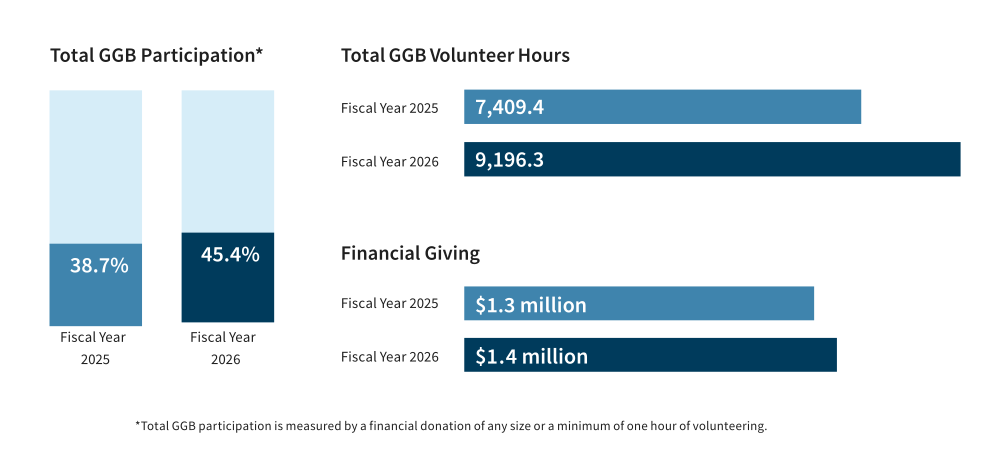
Through Guidewire Gives Back (“GGB”), employees volunteer their time and expertise with nonprofit organizations around the world, creating opportunities to support causes that matter while fostering collaboration across teams. In fiscal year 2026, over 32% of our global workforce contributed more than 9,100 volunteer hours across over 170 nonprofit partnerships, reflecting continued growth in employee participation. Combined, our volunteer hours and donations supported over 1,600 nonprofits worldwide.
Guidewire also partners with customers, universities, and nonprofit organizations to help develop the next generation of insurance and technology professionals. During fiscal year 2026, university programs in India, Canada, and the U.S. provided students with opportunities to apply emerging technologies, including artificial intelligence, to real-world insurance challenges while expanding access to scholarships and mentorship. Guidewire's flagship DEVTrails hackathon in India engaged more than 18,000 engineering students across 30 universities, reinforcing our commitment to building the future talent pipeline for the insurance industry.
Measuring Our Impact
We continued to emphasize and encourage volunteer hours, donations, and customer partnership with our GGB events, achieving the following in our most recent fiscal year:
Fiscal Year 2026 GGB Participation and Financial Giving

Year-over-Year GGB Impact: Participation, Volunteer Hours, and Financial Giving
Investing in Opportunity
Meeting the evolving needs of our customers requires attracting, developing, and retaining talented people with diverse experiences and perspectives. Guidewire is focused on creating multiple pathways into the company while supporting long-term careers that preserve institutional knowledge and strengthen organizational capability.
Our early-career internship programs, return-to-work initiatives, and partnerships with organizations that expand access to technology careers reflect our commitment to broadening opportunities and building sustainable talent pipelines. These programs complement our broader talent strategy by helping individuals enter, re-enter, and grow within the technology industry.
By investing in long-term talent strategies, Guidewire strengthens the capabilities needed to support customers and drive continued innovation.
Investing in Our People
As technology and customer expectations continue to evolve, Guidewire invests in helping employees build the skills, wellbeing, and support needed to succeed throughout their careers.
Employee feedback remains central to how we evolve the workplace experience. Through our ongoing My Voice listening program, employee insights inform decisions across areas including leadership communication, career development, compensation, and the overall employee experience, helping us build a more transparent and responsive organization.
Preparing our workforce for an AI-enabled future also remains a strategic priority. Employees continued building capabilities through Guidewire Insurance University, Education Services, and dedicated AI learning experiences that help strengthen technical expertise and confidence in applying AI to everyday work. Employee Resource Groups further support learning, mentoring, and collaboration by fostering connections across the organization and creating opportunities for professional growth.
Together, these investments help create a workforce that is curious, adaptable, and prepared to meet the evolving needs of our customers and the insurance industry.
Environmental
Climate and Energy
We believe it’s important for the health of both our business and our communities that we invest in measures that reduce the environmental impact of our physical operations, with a focus on operational eco-efficiency and strategic investments that strengthen our company’s resilience, reduce costs, and decrease our carbon footprint. Given the nature of our business, our environmental impacts stem primarily from our Scope 3 emissions (as defined below).
Our Goals Toward a More Sustainable, Low-Carbon Future
In fiscal year 2024, the Science Based Target initiative (“SBTi”) validated our near-term science-based targets (“SBTs”) in line with the long-term goal of the Paris Agreement to limit global warming to 1.5 degrees Celsius1.
Our Climate Targets2
We aim to create and maintain a sustainable, responsible business. To this end, the following near-term science-based emissions reduction target commitments were validated by SBTi:
- Reduce absolute Scope 1 and Scope 2 greenhouse gas (“GHG”) emissions by 50% by fiscal year 2030 compared to our fiscal year 2020 baseline year
- Reduce absolute Scope 3 GHG emissions from fuel and energy related activities (“FERA”), business travel, and employee commuting by 42% within the same timeframe
- Increase to 50% the portion of our suppliers by emissions covering purchased goods and services that have SBTs by fiscal year 2028
In support of increased operational sustainability, we are also working towards sourcing renewable energy for 100% of the global power needs of our offices annually by fiscal year 20303.
Our strategy to achieve and maintain our climate goals are informed by our SBTs and focused on the following pillars:
- Evolving our Supplier Sustainability program: We aim to engage our suppliers in setting SBTs and taking other steps to reduce their environmental impacts. Based on our most recent data, 37.1% of our suppliers by emissions have either committed to or set SBTs.
- Improving efficiency: We have undertaken a range of energy efficiency measures across our operations and plan to implement additional measures in the coming years. Seven of our office buildings hold a green building or green business certification through the landlord, which represents 68.2% of total active square footage as of fiscal year 2026. We received our first LEED v4 Interior Design and Construction (ID+C) Platinum certification for our Bengaluru office. Designed with sustainability in mind, the space features energy-efficient LED lighting with occupancy sensors, water-efficient fixtures, and furniture made with recycled, regional, and environmentally preferred materials. Construction waste was also diverted from landfill.
- Sourcing renewables: We are focused on increasing renewable energy procurement in select Guidewire offices through local utility renewable energy programs and the purchase of renewable energy certificates (“RECs”) to satisfy our 100% renewable energy target where renewable energy options may be limited due to our leasing arrangements. In our most recent reporting period, 47.2% of our energy came from renewable sources, an increase of 1.3% over the prior period.
- Advancing internal climate governance: Our cross-functional Sustainability Task Force and Sustainability Working Group provided guidance on our Climate Risk Assessment and will continue to contribute to the development of key climate and emissions-reduction initiatives.
Our Operational GHG Footprint(a)
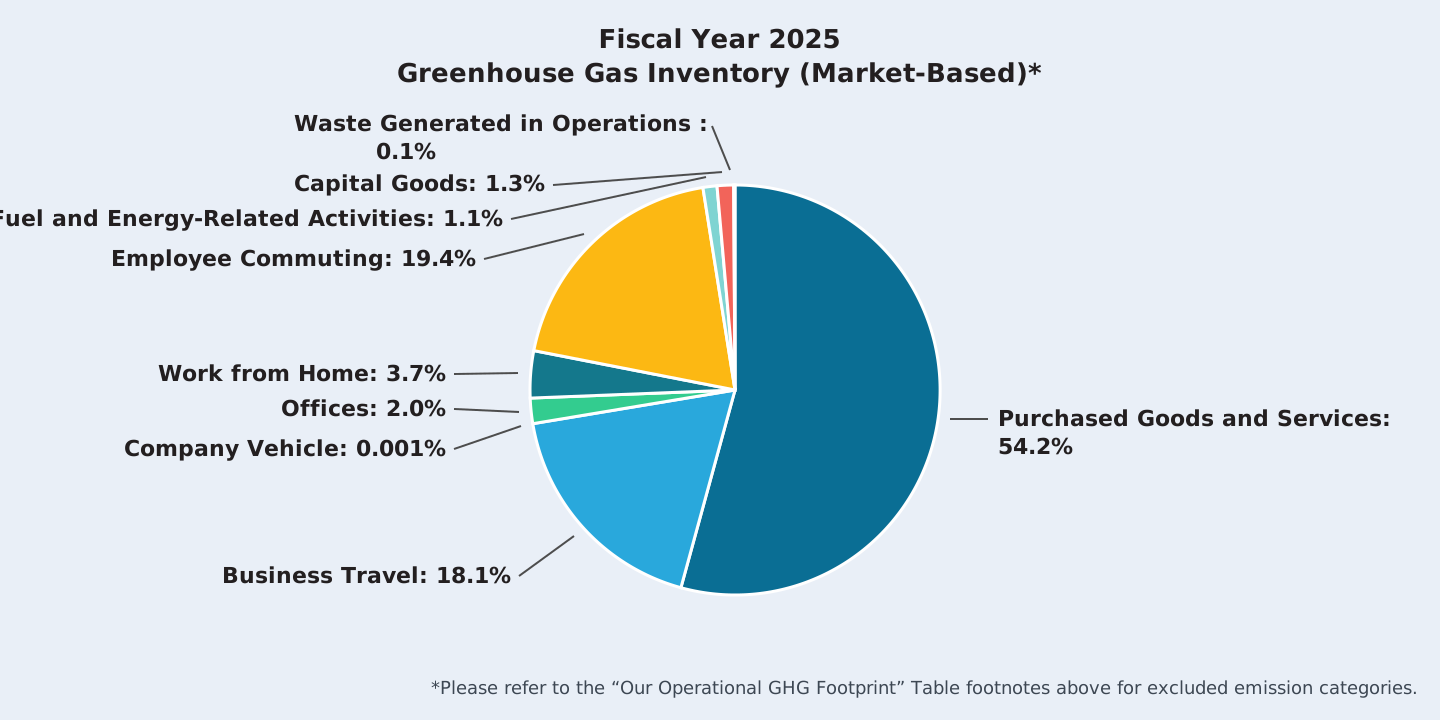
Guidewire’s operational GHG footprint stems from powering our buildings (e.g., electricity, heating, and cooling),4 business travel, and purchased goods and services. Our total absolute Scope 1 and 2 emissions have decreased by 52.7% since our fiscal year 2020 baseline. This decrease reflects the greening of the electrical grid and strategic rightsizing of our real estate portfolio, leading to a decrease in office square footage occupied. The largest drivers of our overall GHG footprint are Scope 3 purchased goods and services and business travel. Our absolute Scope 3 GHG emissions from fuel- and energy-related activities (“FERA”)5, business travel, and employee commuting decreased 5.5% in fiscal year 2025 compared to our fiscal year 2020 baseline, with FERA rising by 23.6%; employee commuting rising by 326.8%, and business travel falling by 48.9%.6.
| Category | Scope 1 | Scope 2(b) | Scope 3(c) |
|---|---|---|---|
| Fiscal Year 2025 Emissions | 26.9 | Location-Based – 1,227.7 Market-Based – 664.6 | Market-Based – 33,048.1 |
| Type | Direct emissions from owned or controlled sources | Indirect emissions from the generation of purchased energy and estimated refrigerants | Other indirect emissions sources |
| Emissions Sources | Fuel to heat buildings, diesel to run generators | Purchased energy for leased facilities for which Guidewire controls the energy usage and pays the utility bills, estimated refrigerants | Business travel, including air, rail, reimbursed personal vehicle, and rental car; purchased goods and services and capital goods; waste and FERA from our leased offices; employee commuting; and work from home |
| % of Fiscal Year 2025 Emissions(d) | 0.1% MtCO2e | 2.0% MtCO2e | 98.0% MtCO2e |
| Emissions Reduction Strategies(e) |
|
|
|
- (a) In fiscal year 2026, we received third-party limited assurance from Apex for our fiscal year 2025 Scope 1, 2, and 3 GHG emissions. Excluded emissions categories are noted in the Environmental Sustainability Data Table footnotes and the External Assurance disclosure in the GRI Index. We expect to report our fiscal year 2026 emissions with limited assurance in or around June 2027.
- (b) Scope 2 GHG emissions are location-based and market-based.
- (c) Scope 3 emissions tracked include: 1) business travel, excluding hotel stays; 2) purchased goods and services and capital goods calculated using spend-based and supplier-specific data; 3) waste estimated based on office square footage, with waste weight collected across four waste streams; 4) FERA based on purchased energy for leased facilities; 5) employee commuting, calculated using badge data and employees’ annualized hours of work and commuting days (geocoding tools were used to calculate the commute distance to determine total annual commuting distance); 6) work-from-home emissions, calculated using Anthesis' methodology; 7) business travel, calculated using air and rail travel, rental cars, and personal employee car mileage for business; air, rail, and rental car information obtained through the travel management platform and travel. agencies, and personal employee car mileage obtained through expense management system; 8) emissions from investments estimated using the spend-based Environmental Economic Input-Output (EEIO) methodology.
- (d) Metric tons of carbon dioxide equivalent.
- (e) The strategies listed are intended to be illustrative of potential reduction options and are not intended to be exhaustive.
- SBTi validated that our near-term SBTs conform with the SBTi Criteria and Recommendations (Criteria version 5.1) in July 2024. ↩
- Please refer to the “Our Operational GHG Footprint” Table on the following page for a breakdown of each scope. ↩
- This target is subject to our ability to source renewable energy options at our office locations, which is not completely within Guidewire’s control. We may explore purchasing renewable energy certificates (“RECs”) where renewable energy options may be limited due to our leasing arrangements. ↩
- We exited our colocated data center in fiscal year 2022 and transitioned to running our operations on AWS, a third-party cloud provider. This transition improved product security, operational efficiency with faster access to newer technology features, and significantly increased energy efficiency. ↩
- Fuel- and energy-related activities are upstream emissions associated with the product of fuels and energy purchased and consumed by Guidewire, such as the extraction, transmission, and distribution of natural gas used in some of our offices. ↩
- Our fiscal year 2020 baseline year included a lower level of employee commuting and business travel due to COVID from March 2020 to July 2020. ↩
Responsible Resource Management
Responsible resource management, including water and waste management, is an important element of our sustainability strategy, helping us reduce our impact while improving efficiency and reducing costs. Our current focus is on reducing our waste footprint, coupled with the responsible disposal of the waste we produce. We also seek to promote responsible water stewardship.
Recycling and Composting
We seek to divert waste from landfills by leveraging municipal recycling and composting programs where they exist. For offices that do not have silverware and china, we use compostable utensils, plates, and cups.
In the most recent fiscal year, we generated more than 7,600 kg of landfill and specialty waste and diverted 75.8% from landfill across thirteen offices, representing 97.9% of our total real estate portfolio by square footage where waste data is collected.1
Sustainability at our London and Sydney Office
Between late 2025 and early 2026, we relocated both our London and Sydney offices to high performance green buildings. Our London team moved to a state-of-the-art office that reflects our commitment to sustainable operations. The building is fully electric, targeting operational net zero carbon, and powered by 100% renewable energy, supported by energy-efficient air source heat pumps and photovoltaic solar roof panels. Notably, the base building boasts a BREEAM Excellent certification and a UK EPCA rating. For our interior fit-out, we capitalized on the building’s abundant natural light and designed a highly efficient, open-plan layout with shared desking to serve our headcount within a compact footprint. The location also supports active, low-carbon commuting by being just a short walk from major transit hubs and offering basement bike storage and shower facilities.
Our new Sydney office demonstrates how selecting a high-performance green building can significantly reduce our environmental impact. By taking over an existing space and making targeted alterations, we minimized construction waste while delivering a modern, functional workspace. The building holds a 5.5-star (out of 6) Australian NABERS Energy rating, with 100% of its base building electricity powered by renewable sources, and a 4.5-star (out of 6) Australian NABERS Water rating. Our lease includes a green lease schedule that requires both Guidewire and the landlord to share and review sustainability metrics annually, ensuring continued progress toward our shared sustainability targets. Employees also benefit from end-of-trip amenities similar to our London office, including 24/7 access to bike racks and showers that support sustainable commuting choices.
E-Waste Circularity and Recycling
We currently provide a nonprofit hardware donation program for a limited amount of out-of-warranty Windows laptops. We host in-person volunteer events at our offices, where employees assist in preparing the laptops for donation by restoring laptops to their original equipment manufacturer operating system. This program promotes circularity by extending the lifespan of electronics goods, resulting in reduced electronic waste while providing our employees with an impactful skills-based volunteer opportunity. Furthermore, our employees nominate nonprofit organizations to receive our in-kind hardware donations. These nonprofits undergo a thorough review process by a joint committee from Business Technology and Sustainability teams, ensuring each nonprofit recipient aligns with the standards of our Guidewire Gives Back program.
We continue to partner with our e-waste recycler, Evergreen IT, to responsibly dispose of older computer hardware, monitors, and peripherals. Whenever our e-waste recycler cannot provide recycling services, we directly contract with the landlord or local e-waste recycle providers. In our most recent fiscal year, we recycled more than 2,700 pieces of electronic equipment and more than 400 lbs of electronic waste materials, such as wires and cables. Additionally, we donated 70 pieces of electronic equipment to nonprofits.
Further, we are committed to procuring ENERGY STAR® and energy efficient laptops and monitors globally.
Green Machine and Zero-Touch Provisioning
For over five years, we have utilized our “Green Machine” program, enabling contractors to use a virtual desktop without the need for a Guidewire-issued computer. This approach promotes resource efficiency by reducing the number of laptops we procure and decommission, lowering physical electronic equipment provisioning from our operations and eliminating the shipping of computers to contractors. In the most recent fiscal year, we improved the program’s operational efficiency by optimizing its underlying AWS infrastructure, and through the removal of inactive accounts and duplicate regional workspaces.
Water Stewardship
We seek to demonstrate water stewardship by reducing water consumption and using water conservation strategies in our operations. In our most recent fiscal year, we collected water consumption information for six of our offices, about 41.3% of our real estate portfolio by square footage. We did not collect water withdrawal information for any of our offices during this period. At present, our ability to comprehensively track and manage water metrics is limited because our real estate portfolio consists exclusively of leased properties, the majority of which are located in multi-tenant buildings or smaller coworking arrangements.
We began assessing water stress in the regions where our offices are located in fiscal year 2024. Currently 36% of the offices in our real estate portfolio are in regions with high or extremely high baseline water stress and 23% of the offices in our real estate portfolio are in regions with medium-high baseline water stress, for a total of 59% of our office locations in regions with medium to high, high, or extremely high baseline water stress, as measured by the World Resources Institute's Water Risk Atlas Tool, Aqueduct.
Regarding water withdrawal and consumption for hardware infrastructure, we use a third-party data center operator (AWS) and do not operate on-premises data centers.
- Fiscal year 2026 waste was calculated for all active offices as of July 31, 2026. Because our office in Edina, Minnesota was closed in June 2026, it was not included in this calculation. ↩
Building Climate Resilience
The scale and impact of climate change present a risk to our business as well as to many stakeholders, notably our customers, communities, and employees. As a result, we are actively managing related risks and investing in sustainability measures across our operations.
Governance and Management Oversight for Climate-Related Activities
We have integrated climate-related considerations into our Enterprise Risk Management (“ERM”) framework and business strategy, ensuring climate risk and opportunity management are embedded across the organization. Our Sustainability, Legal, and Risk functions annually identify, assess, and manage Guidewire’s physical and transition climate-related risks and opportunities (“CRROs”), including mitigation activities for each risk.
| Executive Oversight | Chief Administrative Officer and General Counsel, Head of Sustainability, Chief Information Officer, Senior Director of Workplace, Chief Financial Officer, Chief Accounting Officer, and Vice President of Enterprise Risk Management and Internal Audit Assess climate-related risks and related disclosures. |
|---|---|
| Business Functions |
|
| Committees and Working Groups |
|
| Additional Stakeholders | Guidewire Employees, Customers, Contractors, and Suppliers |
Scenario Analysis and Climate-Related Risks and Opportunities
We began aligning climate-related risks and opportunities with the TCFD recommendations in our public reporting in fiscal year 2022 and published our first TCFD-aligned report in fiscal year 2023. To prepare for upcoming regulations and support future alignment with IFRS S2, we completed a comprehensive climate risk assessment with scenario analysis in fiscal year 2026. Using fiscal year 2025 emissions data and scenario analysis, we identified and prioritized our climate-related risks and opportunities and quantified the financial impacts of our highest priority climate-related risks and opportunities. This assessment was conducted in alignment with TCFD and IFRS S2 requirements.
Physical Risk Assessment
To assess acute and chronic physical risks and aid in planning, we used asset-level climate hazard data to conduct a scenario-analysis screening of existing and anticipated office and data center locations. Sites were evaluated across three time horizons (baseline, 2030, and 2050) using data and projections from three Intergovernmental Panel on Climate Change (“IPCC”) scenarios (referred to as Shared Socioeconomic Pathways or “SSPs”): SSP1-2.6 (low warming), SSP2-4.5 (moderate warming), and SSP5-8.5 (high warming) as outlined in Table 1. The screening modeled 10 acute and chronic hazards for each location1 and the severity of each hazard was defined through quantitative analysis. Since data center street addresses were not available, we used approximate latitude and longitude coordinates for the relevant locations. The scope of this analysis focused on our leased offices and the AWS data centers with the highest usage and projected growth, which represent the most significant elements of our operational and value chain footprint.
Table 1: Physical Assessment Scenarios for climate-related risk and opportunity assessment
| Scenario set | Low Emissions | Moderate Emissions | High Emissions |
|---|---|---|---|
| Physical Assessment Scenarios (IPCC) | SSP1-2.6 | SSP2-4.5 | SSP5-8.5 |
| A low emissions scenario in which global CO2 emissions decline to net zero around 2075, limiting warming to about 1.8°C by 2100 in alignment with the Paris Agreement. | An intermediate emissions scenario where CO2 emissions stay around current levels until mid-century and then decline without reaching net zero by 2100, leading to about 2.7°C warming by 2100. | A very high emissions scenario associated with fossil-fuel-intensive development, in which CO2 emissions roughly triple by late century and warming reaches about 4.4°C by 2100. |
At the conclusion of the risk assessment, we developed a shortlist of risks based on the number of data center and office locations at each exposure level across all hazard types. As we do not own our office buildings or data centers and are not liable for physical damage, the assessment focused on hazards that could disrupt employee access to offices and on physical impacts that could affect service delivery, customer satisfaction, and employee productivity. It also incorporated our ongoing monitoring of acute extreme weather, chronic water stress affecting our offices and AWS data centers, and our existing mitigation strategies, including business continuity plans, regular risk assessments, cross-region disaster recovery capabilities, and AWS’ built-in regional and Availability Zone redundancy. No physical risks were selected for financial quantification because they were assessed as having low priority.2
Transition Risks and Opportunities Assessment
Transition risks and opportunities arise from the global shift to a low-carbon economy. We assessed them under three Network for Greening the Financial System (“NGFS”) scenarios (Net Zero 2050, Delayed Transition, and Current Policies) as shown in Table 2, and across three time horizons (2030, 2040, 2050) as shown in Table 3. The short-term horizon aligns with our ERM risk horizon and SBTi targets, while the longer horizons align with near-term SBTi targets, the Paris Agreement goal of net zero by 2050, and the UK insurance industry’s net-zero-by-2050 commitment. The scenario narratives and parameters—including projected energy costs, carbon pricing, macroeconomic conditions, and regulatory intensity—guided the assessment.
Table 2: Transition Assessment Scenarios for climate-related risk and opportunity assessment
| Scenario set | Low Emissions | Moderate Emissions | High Emissions |
|---|---|---|---|
| Transition Assessment Scenarios (NGFS) | Net Zero 2050 | Delayed Transition | Current Policies |
| A low emissions scenario that limits global warming to 1.5°C through stringent climate policies and innovation, reaching global net zero CO2 emissions around 2050. Physical risks are relatively low but transition risks are high. | An intermediate emissions scenario that assumes global annual emissions do not decrease until 2030. Strong policies are then needed to limit warming to below 2°C. Negative emissions are limited. This leads to both higher transition and physical risks than the Net Zero 2050 scenario. | A high emissions scenario that assumes only currently implemented policies are preserved, leading emissions to grow until 2080 and about 3°C of warming. This leads to high physical risks. |
Table 3: Time horizons for climate-related risk and opportunity scenario analysis
| Time Horizon | Short Term2030 | Medium Term2040 | Long Term2050 |
|---|---|---|---|
| Rationale | Alignment with Guidewire’s 2030 SBTi targets* | Reflects expected changes in transition scenarios between 2030 and 2050 under selected pathways. | Aligned with the Paris Agreement goal to reach net zero emissions around 2050 and keep warming to no more than 1.5°C, and with the UK insurance industry commitment to reach net zero by 2050. |
Using our internal risk register and stakeholder input, the assessment identified six transition risks and six opportunities reflecting market dynamics, industry trends, and our operational footprint. A qualitative scenario analysis across the three climate scenarios and short-, medium-, and long-term horizons found our overall transition risk profile to be low, with carbon pricing mechanisms and rising customer expectations selected for financial quantification as the two most strategically relevant risks. A parallel quantitative assessment of opportunities across the same horizons identified increasing demand for HazardHub as the most strategically relevant opportunity, given its potential to attract new customers and increase revenue.
Quantifying the Financial Impact of Carbon Pricing Mechanisms
Under a high-emissions scenario, carbon pricing risk remains limited where regulated carbon pricing is not projected, while this risk could increase costs associated with our Scope 1,2,3 emissions under a low-emissions scenario. In 2030, modeled financial impacts are modest under both moderate- and low-emissions scenarios but higher in the more stringent low-emissions case, mainly via higher leased-office energy costs and supplier pass-through (e.g., AWS). Over longer horizons3, exposure could grow if carbon pricing becomes more prevalent. To mitigate this risk, we have set near-term Scope 1, 2, and 3 emissions-reduction targets, implemented emissions-reduction initiatives, and committed to sourcing 100% renewable electricity through utility programs. Where the latter is constrained by leasing arrangements, we may explore purchasing renewable energy certificates (“RECs”).
Quantifying the Financial Impact of Increasing Customer Expectations
Customer expectations on climate action may represent a transition risk over longer horizons if customers increasingly factor climate disclosures, emissions-reduction targets, and broader sustainability performance into supplier selection. Many of the customers we serve, particularly those operating across Europe, Canada, Australia, and Japan are already subject to, or preparing for, climate-related reporting and decarbonization requirements, which are likely to raise expectations that suppliers like Guidewire disclose emissions, advance decarbonization, and demonstrate credible climate risk management.
This risk was modeled as directional commercial exposure4 based on how customer expectations and our climate strategy and disclosures could evolve. By 2030, as is consistent with the scenario design, modeled exposure is higher under the low-emissions scenario and moderated under the moderate-emissions scenario, reflecting stronger policy and market-driven procurement requirements, with limited-to-no expected revenue impact under the high-emissions scenario. In no modeled scenario do we anticipate the impact on our revenue to be material by 2030. We used the longer-term time horizons to explore how directional commercial exposure could vary under the different climate scenarios, rather than to predict specific outcomes.
To mitigate this risk, we have set near-term Scope 1, 2, and 3 emissions-reduction targets and continue to make progress against them. Additionally, we have integrated climate considerations into our enterprise risk management and governance frameworks and continue to mature this work. We also monitor sustainability regulations likely to impact Guidewire in key markets both directly or indirectly as a supplier; disclose our progress through our Corporate Sustainability website and CDP; and engage our customers through the Sustainability Business Advisory Council.
Quantifying the Financial Impact of Increasing Demand for HazardHub Products
We identified a climate-related products and services opportunity in HazardHub, reflecting growing insurer demand for tools that assess property-level climate and hazard risk. HazardHub was modeled as a positive financial opportunity across all emissions scenarios and time horizons, with incremental revenue beyond baseline growth strongest in 2030 under the low-emissions scenario due to tighter policy and regulatory drivers, and largest by 2050 under the high-emissions scenario as worsening physical impacts intensify demand for hazard and risk-modeling products.
This opportunity aligns with an existing strategic growth focus, as customers seek better climate-risk intelligence to inform underwriting and market participation in more exposed geographies. To capture this opportunity, we plan to continue investing in climate-risk product innovation, including dedicated R&D to enhance HazardHub and related offerings through improved climate data, model development, competitive benchmarking, and incorporation of evolving science. Similar financial analysis could also extend to climate-risk-related P&C products and broader solutions that support exposure management, pricing, coverage, and claims for climate-affected perils.
- Hazards were grouped into categories like water stress and drought, flooding and storm, extreme cold, wildfire, and extreme heat. ↩
- “Priority” reflects each item’s relative significance within the Climate Risk Assessment only and is not a statement of financial materiality or ranking within Guidewire’s overall risk register. ↩
- Guidewire’s planning materiality benchmark is anchored to a 10-year horizon, so the 2040 and 2050 estimates are not expressed here as percentages of revenue. ↩
- Commercial exposure reflects directional modeled risk based on proxy assumptions about how customer expectations regarding climate action could evolve over time and the extent to which Guidewire’s climate strategy and disclosures keep pace with those expectations. We use this term rather than a specific revenue figure here because the analysis does not rely on observed customer-loss data and remains sensitive to assumptions about customer behavior, supplier requirements, and the timing of market response. ↩
Product Sustainability
Products Enabling Sustainability
Guidewire offers a unique product suite to P&C insurers worldwide. Individually and collectively, these insurers face significant climate-related impacts. Global economic losses from natural catastrophes totaled $220 billion in 2025 with only about 49% insured1. We aim to harness the power of our cloud platform, artificial intelligence (“AI”), core applications, and data and analytics services, as well as our customer relationships and overall knowledge of the industry, to contribute to a more resilient, sustainable insurance industry. Further, we believe a resilient P&C insurance industry is, and will continue to be, critical in protecting individuals, businesses, governments, and communities from increasing losses related to natural catastrophes.
Our Strategy
Our 2023 materiality assessment confirmed that product sustainability is an important topic. Through the materiality assessment, we determined that product sustainability, including products that enable sustainability, cuts across the governance, social, and environmental pillars of sustainability. It also encompasses the topics of climate resilience, emissions and energy, responsible resource management, greater access to insurance, and security and data privacy.
Climate Resilience
Mitigating customers’ climate-related risks and supporting customers’ responses to natural disasters and catastrophes. Integrating climate-risk assessment and pricing into our product offerings to help prevent losses and mitigate risks related to wind, wildfire, and water.
Emissions and Energy
Contributing to clients’ sustainability objectives, net-zero journeys, and waste reduction initiatives through digital products, services, and paperless enablement.
Greater Access to Insurance
Developing products and tools, both at Guidewire and through our partnerships with other firms, that help close the protection gap and support greater access to P&C insurance.
Security and Data Privacy
Protecting systems and networks from theft, damage, and disruption, and ensuring security, particularly when managing client and employee data and privacy.
Products Enabling Climate Resilience, Emissions Reductions, and Greater Access to Insurance
We see opportunities to help insurers strengthen resilience and manage climate-related risk over the next decade. In addition to delivering on our climate goals, we are helping our clients deliver on their sustainability goals and predict and price weather-related risks by:
Innovative Solutions Development
We are exploring product solutions that reduce emissions or promote resilience in response to needs identified by the P&C insurance market and our customers:
- Eco Repair Score: Support the integration of vehicle repair sustainability scoring into digital claims processes so adjusters and repairers can choose less environmentally impactful repair options where appropriate
- EcoClaim: Collaborate on embedding sustainability considerations into property claims workflows, helping carriers factor circularity, waste reduction, and CO2 impacts into repair vs. replace decisions
In addition to evolving existing products and incubating new products with a climate focus, we are strategically investing in and supporting insurtechs with a climate risk or resilience value proposition through our Insurtech Vanguards program and Guidewire Ventures. Both programs promote innovation and deliver value to customers by integrating promising insurtechs into Guidewire’s Marketplace.
- Insurtech Vanguards identifies innovative companies of interest to the P&C insurance industry. Graduated insurtechs with a climate resilience focus include ICEYE, EcoClaim, and zesty.ai. Current insurtechs with a climate risk focus include EcoRepair Score, Faura, Manifest Climate, and Refinq.
- Guidewire Ventures supports companies across the insurance ecosystem that offer innovative solutions to our customer base. Investment criteria includes companies with an insurance focus and an interest in joining the Guidewire Marketplace. Previous and current investments that have a resilience or climate focus include insurtechs such as Betterview, Flyreel, and HOVER.
AI and Cloud Sustainability: We offer our customers Guidewire cloud solutions that leverage AWS, which according to publicly available information regarding AWS’ operations, have a lower carbon footprint than on-premises data centers.2 AWS reports that it has reduced its carbon footprint by designing its data center infrastructure to increase efficiency, including optimizing air-cooling solutions; transitioning to carbon-free energy sources; using purpose-built silicon for AI workloads; employing more sustainable construction practices; improving water efficiency; and applying efficient data storage and replication strategies.3
We continue to work with AWS to assess the environmental footprint of our use of cloud services, including estimated GHG emissions, energy, and water-related considerations. We also work to improve cloud efficiency through measures such as rightsizing infrastructure, reducing over-provisioning and idle resources, using automation and auto-scaling, and managing data storage and retention more efficiently. Based on data made available to us through the AWS Sustainability Console, consolidated estimated GHG emissions associated with Guidewire's and its customers’ use of AWS increased 15.2% from fiscal year 2022 to fiscal year 202545. Over the same period, Annual Recurring Revenue ("ARR")6 grew just over 51%, while AWS emissions intensity, measured as metric tons of emissions per $1 million of AWS spend, declined 34.6%.
Cloud sustainability is also increasingly connected to how we approach AI, as AI becomes more foundational to how we build products, manage internal operations, and support customers. As we expand the use of AI across our business, we are considering how model selection, use case design, architecture, infrastructure choices, and deployment decisions can affect compute demand and associated environmental impacts. While cloud infrastructure and AI models are both operated by third-party providers, we continue to assess how our own design and operational decisions can influence sustainability outcomes through resource efficiency, scaling, storage and retention practices, and broader cloud and AI usage optimization. We are also seeing increased interest in these topics from customers and the broader market. As our use of AI evolves, we intend to continue monitoring AWS-related and other service provider emissions while further assessing how cloud efficiency, AI usage, customer expectations, and related governance considerations may shape our broader sustainability approach.
More broadly, we continue to offer customers core operational solutions that support digital and paperless engagement, helping reduce paper waste through the end-to-end policy lifecycle.
Climate Resilience and Greater Access to Insurance: Supporting a more sustainable, resilient insurance ecosystem by helping to reverse the growing protection gap—the disparity between total economic losses from climate-driven events and insured coverage—is a central part of our product sustainability strategy. We support a more resilient insurance ecosystem through product innovation, more accurate pricing, expanded distribution, and products such as HazardHub. HazardHub can operate as an API or integrate with ClaimCenter and InsuranceNow to help insurers identify insurable properties, encourage proactive risk mitigation, price premiums more accurately, and support long-term coverage stability.
In fiscal year 2026, we significantly advanced these capabilities by introducing a suite of next-generation models and substantially expanding insurer access to HazardHub’s multi-peril models across 41 U.S. states, with additional state approvals pending or planned. This suite includes our most predictive fire protection model that delivers granular, address-level emergency service metrics, alongside our wildfire, flood, wind, and hail models. By also identifying specific, actionable risk factors at the individual parcel level, such as fuel density or structural vulnerabilities, our data enables policyholders to undertake proactive loss prevention measures, such as clearing brush around structures in fire-prone areas.
The Insurance Information Institute’s 2025 case study on wildfire insurance access in underserved areas of California demonstrated how geospatial data analysis using HazardHub's predictive Wildfire Score methodology can identify lower-risk properties, even within regions traditionally classified as high-risk. This precision allows carriers to safely expand their underwriting appetite, maintain market availability, and optimize coverage where it is needed most. ClaimCenter and related products further support this mission by enabling insurers to deliver a comprehensive, proactive, and timely disaster response that accelerates community recovery.
Additionally, as a member of the World Economic Forum’s Center for Nature and Climate’s Global Wildfire Network we contributed to efforts exploring how digital platforms can support prevention, preparedness, and recovery for communities and businesses. We also supported dialogue on how insurers can incentivize risk-reducing investments and more resilient rebuilding after events.
We also continued our partnership with the Insurance Information Institute/PwC Dallas Resilience Initiative and Resilient Homes America to turn resilience concepts into scalable, insurer-ready programs. Our work included sharing insights on how insurers can operationalize home-hardening and resilience incentives within underwriting, policy, and claims workflows, exploring how cloud platforms and analytics can help design, target, and administer resilience programs at neighborhood and city level, and supporting collaboration between insurers, policymakers, and communities to make resilient homes both insurable and affordable.
Contributing to public discourse on products enabling sustainability: We are beginning to work with customers, business partners, and industry associations, among others, to enable and act on climate resiliency efforts through the deployment of our solutions and contributions to thought leadership. To date, this work has included supporting reforms to California’s insurance market to ensure resiliency.
- Swiss Re, “Wildfires, Storms, Floods Contribute to Record 92% of Global Insured Losses in 2025, Says Swiss Re Institute,” Swiss Re, March 19, 2026, swissre.com. ↩
- Accenture, “How Moving onto the AWS Cloud Reduces Carbon Emissions,” study commissioned by Amazon Web Services, referenced in Amazon Staff, “How AWS Helps Reduce Carbon Footprint of AI Workloads,” About Amazon, June 25, 2024, accessed June 18, 2026, aboutamazon.com. ↩
- Amazon Staff, “How AWS Helps Reduce Carbon Footprint of AI Workloads,” About Amazon, June 25, 2024, accessed June 18, 2026, aboutamazon.com. ↩
- Fiscal year 2022 AWS emissions are estimated. AWS Sustainability Console v3.0.1 data for fiscal year 2022 was estimated using the average of the non-anomalous reported months in calendar year 2022 to replace the anomalous data in March 2022 and estimate missing data from August through December 2021. ↩
- Amazon Staff, “How AWS Helps Reduce Carbon Footprint of AI Workloads,” About Amazon, June 25, 2024, accessed June 18, 2025; Amazon Web Services, “Calculation Methodology,” AWS Sustainability Documentation, accessed June 18, 2025. AWS emissions data in this report reflect updated AWS Sustainability Console methodology. AWS states that its methodology is based on the GHG Protocol and ISO 14064, ISO 14040, and ISO 14044, and that historical data is recalculated when methodology updates are released to improve comparability over time. AWS methodology update materials also reference ISO 14067. ↩
- Fiscal year 2022 ARR based on currency exchange rates as of July 31, 2021 and fiscal year 2025 ARR based on currency exchange rates as of July 31, 2024. ↩
Appendix
Sustainability Data Tables
Economic
| Financial Impact(1,2) | 2020 | 2024 | 2025 | 2026 | 2026 Change vs 2020 |
|---|---|---|---|---|---|
| Revenue (millions)(3) | $742.3 | $980.5 | $1,202.5 | $1,475.4 | 98.8% |
| Guidewire Financial Giving (millions)(4) | n/a(5) | $1.3 | $1.3 | $1.4 | n/a |
| Employee Volunteer Hours(6) | 3,728.0 | 9,130.9 | 7,409.4 | 9,196.3 | 146.7% |
- (1)All years referenced in the Sustainability Data Tables align with fiscal years unless otherwise indicated. We have designated fiscal year 2020 as the baseline year in this table.
- (2)All financial impact metrics are global and listed in USD unless otherwise indicated.
- (3)Please refer to our 2026 Annual Report on Form 10-K for additional financial performance data.
- (4)Figure includes Guidewire charitable contributions and employee giving, but excludes estimated financial impact of employee volunteer hours.
- (5)We began tracking employee volunteer hours as well as corporate and employee charitable contributions through a charitable donation-management and volunteer-management software platform in fiscal year 2021. As such, we are not able to report company and employee charitable contributions from fiscal year 2020.
- (6)Volunteer hours are global.
Workforce Demographics
| Workforce Representation(1,2) | 2020 | 2024 | 2025 | 2026 | 2026 Change vs 2020 |
|---|---|---|---|---|---|
| Global Employees(3) | 2,690 | 3,469 | 3,772 | 4,174 | 55.2% |
| % Region | |||||
| Employees in U.S. | 59.5% | 48.8% | 45.4% | 42.2% | -17.3% |
| Employees outside U.S./Employees Internationally | 40.5% | 51.2% | 54.6% | 57.8% | 17.3% |
| Employees in APAC | 5.9% | 14.8% | 19.8% | 23.7% | 17.8% |
| Employees in AMER | 65.6% | 57.6% | 53.8% | 52.5% | -13.1% |
| Employees in EMEA | 28.5% | 27.6% | 26.4% | 23.8% | -4.7% |
| % Employee Type(4) | |||||
| Full-Time | 99.4% | 99.3% | 99.4% | 99.4% | —% |
| Part-Time | 0.6% | 0.7% | 0.6% | 0.6% | —% |
| Contract | 763 | 731 | 887 | 1,162 | 52.3% |
| Interns | 32 | 50 | 69 | 59 | 84.4% |
- (1)All years represented in the Sustainability Data Tables align with fiscal years unless otherwise indicated. We have designated fiscal year 2020 as the baseline year in this table. Workforce representation totals may not equal 100% due to rounding. Figures are based on self-identification data only and percentages are rounded to the nearest tenth of a point. Gender data is from Guidewire employees around the world. All race and ethnicity data applies to U.S.-based employees only.
- (2)The percentage of employees choosing not to disclose gender and/or race and ethnic data is provided for every year of data reported. Metrics included in these tables represent a snapshot in time.
- (3)Figures represent full-time and part-time employees as well as interns (with the exception of interns in Malaysia and Spain) and exclude employees hired on a contract basis.
- (4)Figures are global.
| Gender (Global)(1) | 2020(2) | 2024(3) | 2025(4) | 2026(5) | 2026 Change vs 2020 |
|---|---|---|---|---|---|
| % Female | |||||
| Overall | 27.5% | 29.8% | 30.6% | 31.4% | 3.9% |
| % Male | |||||
| Overall | 72.5% | 70.0% | 69.3% | 68.6% | -3.9% |
| Race/Ethnicity (US)(1) | 2020(6) | 2024(7) | 2025(8) | 2026(9) | 2026 Change vs 2020 |
|---|---|---|---|---|---|
| % Asian | |||||
| Overall | 34.9% | 34.7% | 34.6% | 36.3% | 1.4% |
| % Black or African American | |||||
| Overall | 1.4% | 2.4% | 2.3% | 2.0% | 0.6% |
| % Indigenous(10) | |||||
| Overall | 0.6% | 0.5% | 0.6% | 0.6% | —% |
| % Hispanic or Latinx | |||||
| Overall | 3.2% | 4.0% | 4.1% | 4.1% | 0.9% |
| % Two or More Races | |||||
| Overall | 1.6% | 2.0% | 2.5% | 2.3% | 0.7% |
| % White | |||||
| Overall | 41.3% | 43.4% | 43.6% | 43.3% | 2.0% |
- (1)All years referenced in the Sustainability Data Tables align with fiscal years unless otherwise indicated. We have designated fiscal year 2020 as the baseline year in this table.
- (2)< 0.1% of employees globally declined to disclose their gender in fiscal year 2020.
- (3)0.1% of employees globally declined to disclose their gender in fiscal year 2024.
- (4)0.08% of employees globally declined to disclose their gender in fiscal year 2025.
- (5)0.07% of employees globally declined to disclose their gender in fiscal year 2026.
- (6)17.1% of employees in the U.S. declined to disclose their race/ethnicity in fiscal year 2020.
- (7)13.0% of employees in the U.S. declined to disclose their race/ethnicity in fiscal year 2024.
- (8)12.3% of employees in the U.S. declined to disclose their race/ethnicity in fiscal year 2025.
- (9)11.4% of employees in the U.S. declined to disclose their race/ethnicity in fiscal year 2026.
- (10)Indigenous is defined as Native Pacific Islander or Hawaiian, Alaska Native, or American Indian.
| Gender Hiring (Global)(1,2) | 2020 | 2024(3) | 2025 | 2026(4) | 2026 Change vs 2020 |
|---|---|---|---|---|---|
| % Female | 27.5% | 35.6% | 36.8% | 35.4% | 7.9% |
| % Male | 72.5% | 64.1% | 63.2% | 64.5% | -8.0% |
| Race/Ethnicity Hiring (U.S.)(1,2) | 2020(5) | 2024(6) | 2025(7) | 2026(8) | 2026 Change vs 2020 |
|---|---|---|---|---|---|
| % Asian | 40.1% | 34.1% | 34.1% | 37.7% | -2.4% |
| % Black or African American | 2.9% | 4.3% | 4.7% | 1.6% | -1.3% |
| % Indigenous(9) | 1.1% | 1.4% | 0.0% | 0.5% | -0.6% |
| % Hispanic or Latinx | 3.6% | 8.7% | 9.4% | 5.2% | 1.6% |
| % Two or More Races | 1.5% | 5.1% | 5.3% | 1.6% | 0.1% |
| % White | 46.0% | 42.0% | 39.4% | 49.2% | 3.2% |
- (1)All years referenced in the Sustainability Data Tables align with fiscal years unless otherwise indicated. We have designated fiscal year 2020 as the baseline year in this table. Hiring totals may not equal 100% due to rounding.
- (2)Hiring data includes full-time and part-time employees, as well as interns (with the exception of interns in Malaysia and Spain), and excludes employees hired on a contract basis.
- (3)0.3% of new hires globally declined to disclose their gender in fiscal year 2024.
- (4)0.1% of new hires globally declined to disclose their gender in fiscal year 2026.
- (5)4.4% of new hires in the U.S. declined to disclose their race/ethnicity in fiscal year 2020.
- (6)4.4% of new hires in the U.S. declined to disclose their race/ethnicity in fiscal year 2024.
- (7)7.1% of new hires in the U.S. declined to disclose their race/ethnicity in fiscal year 2025.
- (8)4.2% of new hires in the U.S. declined to disclose their race/ethnicity in fiscal year 2026.
- (9)Indigenous is defined as Native Pacific Islander or Hawaiian, Alaska Native, or American Indian.
Environmental
| Environmental Impact(1,2,3,4,5) | 2020 | 2023(6) | 2024 | 2025 | 2025 Change vs 2020 |
|---|---|---|---|---|---|
| Scope 1 GHG Emissions (metric tons CO2e) | 41.2 | 30.8 | 26.0 | 26.9 | -34.7% |
| Scope 2 GHG Location-Based Emissions (metric tons CO2e) | 1,688.5 | 1,306.8 | 1,246.5 | 1,227.7 | -27.3% |
| Scope 2 GHG Market-Based Emissions (metric tons CO2e) | 1,421.6 | 729.0 | 810.9 | 664.6 | -53.2% |
| Scope 3 GHG Emissions Total (metric tons CO2e)(7,8) | 39,652.3 | 30,622.1 | 32,486.3 | 33,048.1 | -16.7% |
| Business Travel(9) | 11,972.5 | 6,366.5 | 8,537.1 | 6,117.8 | -48.9% |
| Purchased Goods and Services(10) | 23,999.5 | 17,625.0 | 17,797.9 | 18,297.0 | -23.8% |
| Capital Goods | 386.9 | 798.6 | 880.3 | 448.2 | 15.8% |
| Fuel and Energy Related Activities (FERA) | 300.9 | 176.0 | 324.9 | 371.9 | 23.6% |
| Employee Commuting | 1,536.8 | 3,968.2 | 3,664.1 | 6,558.9 | 326.8% |
| Work from Home | 1,380.5 | 1,673.5 | 1,242.5 | 1,232.1 | -10.7% |
| Waste Generated in Operations(11) | 75.2 | 14.3 | 39.5 | 22.2 | -70.5% |
| Total Measured Market-Based GHG Emissions (metric tons CO2e) | 41,115.1 | 31,381.9 | 33,323.2 | 33,739.6 | -17.9% |
| Emissions Intensity Per Square Foot (metric tons CO2e per sq ft) | 0.085 | 0.060 | 0.093 | 0.077 | -9.0% |
| Energy consumption (megawatt hours) | 6,902.4 | 4,454.8 | 4,332.2 | 4,496.5 | -34.9% |
| Direct Energy Consumption (megawatt hours) | 227.1 | 154.5 | 142.3 | 148.3 | -34.7% |
| Indirect Energy Consumption (megawatt hours) | 6,675.4 | 4,300.3 | 4,189.9 | 4,348.2 | -34.9% |
| Energy Intensity per Square Foot (megawatt hours per sq ft) | 0.014 | 0.008 | 0.012 | 0.010 | -27.8% |
| GHG Emissions per Revenue (metric tons CO2e per $1 million revenue) | 55.3 | 34.7 | 34.0 | 28.1 | -49.3% |
| % of Electricity from Renewable Sources | 33.9% | 64.4% | 63.5% | 65.3% | 31.4% |
| % of Total Energy from Renewable Sources | 28.2% | 51.0% | 45.9% | 47.2% | 19.0% |
- (1)All years referenced in the Environmental Sustainability Data Table align with fiscal years unless otherwise indicated. We have designated fiscal year 2020 as the baseline year in this table.
- (2)Our Scope 1, 2, and 3 GHG emissions for fiscal years 2023, 2024, and 2025 received limited assurance from Apex. For fiscal year 2023 the following Scope 2 and 3 categories were not assured: purchased goods and services; investments; business travel bookings for employees in Japan, Brazil, and India; and FERA for our Sydney, Australia office. Additionally, emissions from purchased goods and services were recalculated after receiving assurance. For more information, please see footnote 10 and 11.
- (3)Our GHG reporting methodologies are guided by the Greenhouse Gas Protocol Corporate Accounting and Reporting Standard.
- (4)GHG emissions breakdown by geographic region is available in our 2025 CDP Corporate Questionnaire. Our 2026 CDP Corporate Questionnaire will be released in February 2026 and linked in June 2027.
- (5)The fiscal year 2025 External Assurance Statement for Scope 1,2, and 3 GHG emissions is available here. Fiscal year 2026 Scope 1, 2, and 3 GHG emissions, updated calculations, and the Fiscal year 2026 External Assurance Statement will be added in or around June 2027.
- (6)Scope 2 and 3 emissions from FERA for our Sydney, Australia office were omitted from our 2023 GHG inventory. We included Scope 2 and 3 emissions from FERA for our Sydney, Australia office in our 2024 GHG inventory and intend to do so moving forward.
- (7)Scope 3 emissions tracked in fiscal year 2025 include: 1) business travel, excluding hotel stays; 2) purchased goods and services and capital goods calculated using spend-based and supplier specific data; 3) waste estimated based on office square footage and waste weight was collected across four waste streams; 4) FERA based on purchased energy for leased facilities; 5) employee commuting calculated using badge data and employees’ commuting days (geocoding tools were used to calculate the commute distance to determine total annual commuting distance); 6) work from home emissions calculated using Anthesis' methodology; 7) business travel calculated using air and rail travel, rental cars, and personal employee car mileage for business; air, rail, and rental car information obtained through travel management platform and travel agencies, and personal employee car mileage obtained through expense management system; 8) emissions from investments estimated using the spend based Environmental Economic Input-Output (“EEIO”) methodology. We do not include all 15 categories of Scope 3 emissions in our calculations or targets.
- (8)Investment emissions were calculated for fiscal years 2020, 2022, 2024, 2025. We have historically omitted investment emissions from our GHG inventory Scope 3 as they have comprised less than 5% of our overall emissions. We intend to calculate investment emissions for fiscal year 2026 and will provide an updated footnote in June 2027 regarding whether investment emissions have been omitted from our fiscal year 2026 GHG inventory Scope 3 due to making up less than 5% of our overall emissions.
- (9)From fiscal years 2020 to 2023, travel bookings from employees in India and Japan were omitted from our GHG inventories. We included travel booked by employees in India and Japan in our fiscal year 2024 Scope 3 business travel emissions and intend to continue to do so moving forward.
- (10)Due to better quality data becoming available, we recalculated our fiscal year 2022, 2023, 2024,2025 Scope 3 purchased goods and services emissions. As such, the fiscal year 2022, 2023, 2024, 2025 updated Scope 3 purchased goods and services emissions we are reporting have not been externally assured by Apex. As a result, this also changed our total measured market-based GHG emissions, GHG emissions per revenue, emissions intensity per square foot for these years.
- (11)We used a different measurement methodology to calculate our fiscal year 2023 Scope 3 waste category emissions. We used the same measurement methodology for 2020, 2022, 2024, and 2025, and intend to use that methodology moving forward.
GRI Index
We report social and governance information in this section for the fiscal year ended 2026 and environmental information in this section for the fiscal year ended 20251. Social, governance, and environmental performance metrics and narrative disclosures may extend beyond these periods where relevant to our sustainability strategy and ongoing initiatives. We referenced the following GRI Standards in preparing this content index: GRI 1: Foundation 2021, GRI 2: General Disclosures 2021, GRI 3: Material Topics, GRI 101: Biodiversity 2024, GRI 201: Economic Performance 2016, GRI 202: Market Presence 2016, GRI 203: Indirect Economic Impacts 2016, GRI 205: Anti-Corruption 2016, GRI 206: Anti-Competitive Behavior 2016, GRI 207: Tax 2019, GRI 302: Energy 2016, GRI 303: Water and Effluents 2018, GRI 305: Emissions 2016, GRI 306: Waste 2020, GRI 308: Supplier Environmental Assessment 2016, GRI 401: Employment 2016, GRI 403: Occupational Health and Safety 2018, GRI 404: Training and Education 2016, GRI 405: Diversity and Equal Opportunity 2016, GRI 413: Local Communities 2016, GRI 414: Supplier Social Assessment 2016, GRI 415: Public Policy 2016, and GRI 418: Customer Privacy 2016.
| Indicator | References and Responses |
|---|---|
| General Disclosures | |
| 2-1 Organizational Details |
2026 Annual Report on Form 10-K, Cover Page, Exhibits 3.1 and 21.1 Corporate Sustainability, Guidewire at a Glance |
| 2-2 Entities Included in the Organization’s Sustainability Reporting | |
| 2-3 Reporting Period, Frequency, and Contact Point |
Corporate Sustainability, Cautionary Language Concerning Forward-Looking Statements; About Our Reporting Contact: Sustainability@guidewire.com |
| 2-4 Restatements of Information |
NOTE: Guidewire restated previously reported fiscal year 2022- 2025 AWS emissions and corresponding Scope 3 purchased goods and services emissions due to a change in AWS’ customer emissions methodology in January 2026. As a result, previously reported Scope 3 emissions for fiscal years 2022-2025 that were affected by AWS information were updated, and the updated fiscal year 2022-2025 Scope 3 purchased goods and services emissions have not been externally assured. For restatements from prior years, please see our archived Sustainability Reports. |
| 2-5 External Assurance |
NOTE: Apex Companies provided limited external assurance for Guidewire’s fiscal years 2021-2025 Scope 1, 2, and 3 GHG emissions. For fiscal year 2023, the following Scope 2 and Scope 3 categories were excluded from assurance: investments; business travel bookings for employees in Brazil, Japan, and India; and fuel- and energy-related activities (FERA) for our Sydney, Australia office. We also did not report or receive assurance for business travel bookings for employees in Brazil for fiscal years 2020-2024 and for employees in Japan and India for fiscal years 2020-2022. In addition, due to a change in AWS’ methodology, we recalculated our fiscal year 2022-2025 AWS emissions and corresponding Scope 3 purchased goods and services emissions. Additionally, fiscal year 2022 AWS emissions included estimated values due to missing and anomalous data. Accordingly, the updated fiscal year 2022-2025 Scope 3 purchased goods and services emissions we report have not been externally assured by Apex. We expect to receive limited external assurance for our fiscal year 2026 Scope 1, 2, and 3 GHG emissions in 2027. We did not seek or receive third-party external assurance with respect to other information. Corporate Sustainability, About Our Reporting; Sustainability Governance; GRI Index; Fiscal Year 2025 GHG Inventory Assurance* |
| 2-6 Activities, Value Chain, and Other Business Relationships |
2026 Annual Report on Form 10-K, Part I. Item l. Business Corporate Sustainability, Guidewire at a Glance; Responsible Sourcing and Procurement; How Our People Power Intelligent Insurance; Products Enabling Sustainability |
| 2-7 Employees |
2026 Annual Report on Form 10-K, Part I. Item 1. Business (Employees and Human Capital Resources) Corporate Sustainability, How Our People Power Intelligent Insurance; Sustainability Data Tables |
| 2-8 Workers Who Are Not Employees |
Corporate Sustainability, Sustainability Data Tables |
| 2-9 Governance Structure and Composition |
Corporate Sustainability, Sustainability Governance; How Our People Power Intelligent Insurance |
| 2-10 Nomination and Selection of the Highest Governance Body |
2025 Proxy Statement, Our Board of Directors; Proposal One: Election of Directors** |
| 2-11 Chair of the Highest Governance Body | |
| 2-12 Role of the Highest Governance Body in Overseeing the Management of Impacts |
2025 Proxy Statement, Information About the Board and Corporate Governance** Corporate Sustainability, Sustainability Governance; Stakeholder Engagement |
| 2-13 Delegation of Responsibility for Managing Impacts |
2025 Proxy Statement, Information About the Board and Corporate Governance** Corporate Sustainability, Sustainability Governance; Topic-specific discussions throughout the Corporate Sustainability website |
| 2-14 Role of the Highest Governance Body in Sustainability Reporting |
2025 Proxy Statement, Information About the Board and Corporate Governance** Corporate Sustainability, Sustainability Governance; Building Climate Resilience |
| 2-15 Conflicts of Interest | |
| 2-16 Communication of Critical Concerns |
2025 Proxy Statement, Information About the Board and Corporate Governance** |
| 2-17 Collective Knowledge of the Highest Governance Body |
2025 Proxy Statement, Information About the Board and Corporate Governance** Corporate Sustainability, Sustainability Governance; Governance and Ethics |
| 2-18 Evaluation of the Performance of the Highest Governance Body |
2025 Proxy Statement, Information About the Board and Corporate Governance** Corporate Sustainability, Sustainability Governance |
| 2-19 Remuneration Policies | |
| 2-20 Process to Determine Remuneration |
2025 Proxy Statement, Compensation Discussion and Analysis** Corporate Sustainability, How Our People Power Intelligent Insurance |
| 2-21 Annual Total Compensation Ratio |
2025 Proxy Statement, Compensation Discussion and Analysis** |
| 2-22 Statement on Sustainable Development Strategy |
2025 Proxy Statement, Information About the Board and Corporate Governance** Corporate Sustainability, Our Goals |
| 2-23 Policy Commitments |
NOTE: Guidewire's positions on various sustainability topics are described in several policies, some of which are publicly available on our Corporate Sustainability website and linked below. These policies describe our current practices, approaches, positions, and commitments related to environmental, social, and governance aspects of our business. As Guidewire's sustainability programs, practices, performance, and commitments evolve and grow, we may modify these policies and post revised versions: Corporate Sustainability, Sustainability Governance; Our Goals Code of Business Conduct and Ethics Environmental Policy Statement UK Modern Slavery Act Statement Occupational Health and Safety Policy*** Equal Opportunities Policy*** Customer Data Privacy Policy*** Political Contributions Policy*** |
| 2-24 Embedding Policy Commitments |
NOTE: Guidewire's policies on various sustainability topics describe our current practices, approaches, positions, and commitments related to environmental, social, and governance aspects of our business. Code of Business Conduct and Ethics Environmental Policy Statement UK Modern Slavery Act Statement Occupational Health and Safety Policy*** Equal Opportunities Policy*** Customer Data Privacy Policy*** Political Contributions Policy*** |
| 2-25 Processes to Remediate Negative Impacts |
2025 Proxy Statement, Information About the Board and Corporate Governance** Corporate Sustainability, Governance and Ethics Code of Business Conduct and Ethics Environmental Policy Statement UK Modern Slavery Act Statement Global Anti-Corruption Policy*** Occupational Health and Safety Policy*** Customer Data Privacy Policy*** |
| 2-26 Mechanisms for Seeking Advice and Raising Concerns |
2025 Proxy Statement, Information About the Board and Corporate Governance** Corporate Sustainability, Governance and Ethics Code of Business Conduct and Ethics Anti-Retaliation Policy*** |
| 2-27 Compliance with Laws and Regulations |
2025 Annual Report on Form 10-K, Part II. Item 9A. Controls and Procedures Corporate Sustainability, Governance and Ethics |
| 2-28 Membership Associations |
NOTE: Guidewire's sustainability-focused voluntary partnerships, working groups, memberships, and affiliations have been vital to the progress that we have made in our sustainability journey. We will continue to explore how we can enhance our contributions to our current partnerships, while also forging new ones to amplify our impact. In fiscal year 2026, our affiliations with, or endorsements of, externally developed economic, environmental, and social charters, principles, or other initiatives to which we subscribe, along with key memberships in industry associations, and national and international advocacy organizations, include: Business Advisory Council Sustainability Group sponsored by Guidewire CDP Enhanced Disclosure Supporter Financial Services Information Sharing and Analysis Center (FS-ISAC) IT-ISAC Critical SaaS Special Interest Group (SIG) World Economic Forum's Centre for Cybersecurity Partner World Economic Forum’s Centre for Financial and Monetary Systems World Economic Forum's Centre for Nature and Climate and Extreme Heat Resilience Working Group World Economic Forum’s Global Wildfire Resiliency Network |
| 2-29 Approach to Stakeholder Engagement |
2025 Proxy Statement, Compensation Discussion and Analysis** Corporate Sustainability, Stakeholder Engagement |
| 2-30 Collective Bargaining Agreements |
NOTE: Our employees in the U.S. are not represented by labor unions. However, in certain foreign jurisdictions, there are workers' councils that represent our employees. To date we have not experienced any work stoppages, and we invest in maintaining productive employee relations. 2026 Annual Report on Form 10-K, Part I. Item l. Business (Employees and Human Capital Resources) |
| Material Topics | |
| 3-1 Process to Determine Material Topics |
Corporate Sustainability, Our Goals |
| 3-2 List of Material Topics |
Corporate Sustainability, Our Goals |
| 3-3 Management of Material Topics |
Corporate Sustainability, Our Goals; Stakeholder Engagement; Governance and Ethics; Security and Data Privacy; Responsible Sourcing and Procurement; How Our People Power Intelligent Insurance; Climate and Energy; Responsible Resource Management; Building Climate Resilience; Products Enabling Sustainability; Sustainability Data Tables; GRI Index; SASB Index; TCFD Index 2025 CDP Corporate Questionnaire**** Code of Business Conduct and Ethics Environmental Policy Statement UK Modern Slavery Act Statement Occupational Health and Safety Policy*** Equal Opportunity Policy*** Customer Data Privacy Policy*** Political Contributions Policy*** Global Anti-Corruption Policy*** Anti-Retaliation Policy*** |
| Topic Disclosures | |
| 101 Biodiversity | |
| 101-2 Management of Biodiversity Impacts |
NOTE: As a software company with a leased office footprint, Guidewire does not currently have significant direct operational impacts on biodiversity. Guidewire has limited direct biodiversity impact because operations are primarily leased urban offices, but it recognizes possible indirect biodiversity impacts through its value chain, especially third-party cloud infrastructure; it does not currently undertake habitat protection or restoration activities as a core operating practice. |
| 201 Economic Performance | |
| 201-1 Direct Economic Value Generated |
2026 Annual Report on Form 10-K Corporate Sustainability, Sustainability Data Tables |
| 201-2 Financial Implications and Other Risks and Opportunities Due to Climate Change |
2026 Annual Report on Form 10-K, Part I. Item IA. Risk Factors Corporate Sustainability, Building Climate Resilience; TCFD Index 2025 CDP Corporate Questionnaire, C3. Disclosure of Risks and Opportunities; C5. Business Strategy**** |
| 201-3 Defined Benefit Plan Obligations and Other Retirement Plans |
2026 Annual Report on Form 10-K, Part II. Item 8. Financial Statements and Supplemental Data |
| 201-4 Financial Assistance Received from the Government | |
| 202 Market Presence | |
| 202-1 Ratios of Standard Entry Level Wage by Gender Compared to Local Minimum Wage |
NOTE: Guidewire does not have employees who are paid at or near minimum wage. We seek to maintain fair and competitive compensation practices by benchmarking compensation against relevant market data and considering local market conditions. 2025 Proxy Statement, Compensation Discussion and Analysis** |
| 202-2 Proportion of Senior Management Hired from the Local Community |
NOTE: We promote the recruitment and promotion of local employees at all levels of our organization. We do not currently record the proportion of senior managers who are hired from certain local communities although we continue to consider such matters as part of the strategic human capital management of our Company. |
| 203 Indirect Economic Impacts | |
| 203-1 Infrastructure Investments and Services supported |
NOTE: We established our India ElevatED by Guidewire program in fiscal year 2025 in partnership with the Foundation for Excellence India. This multi-year engineering scholarship fund provides educational assistance and professional development, including specialized training, mentorship, and internship opportunities, to female college students from low-income backgrounds who are pursuing degrees in technology and engineering. Corporate Sustainability, How Our People Power Intelligent Insurance |
| 205 Anti-Corruption | |
| 205-2 Communication and Training about Anti-Corruption Policies and Procedures |
Corporate Sustainability, Governance and Ethics Code of Business Conduct and Ethics Global Anti-Corruption Policy*** |
| 206 Anti-Competitive Behavior | |
| 206-1 Legal Actions for Anti-Competitive Behavior, Anti-Trust, and Monopoly Practices |
NOTE: Guidewire was not a participant in any pending or completed legal actions related to anti-competitive behavior, antitrust, or monopoly practices during the reporting period. As a result, no fines, settlements, or judicial decisions were recorded. |
| 207 Tax | |
| 207-1 Approach to Tax |
NOTE: Guidewire seeks to comply with applicable tax laws and regulations in the jurisdictions in which we operate and to pay the required taxes we owe, including corporate income, employment, and indirect taxes. We do not tolerate or facilitate tax evasion. Our approach to tax is supported by our broader tax governance and compliance practices. We manage our tax affairs with reference to current and relevant legislation and seek to ensure that tax follows the commercial substance of our activities rather than driving business decisions. Where appropriate, we may make use of available tax incentives, reliefs, and exemptions where these are consistent with both the spirit and the letter of the law. |
| 207-2 Tax Governance, Control, and Risk Management |
NOTE: Guidewire’s tax costs and risks are managed by an experienced group of tax professionals with oversight from our finance function and other internal oversight channels. Where appropriate, we consult external tax advisors on significant or uncertain tax matters. Day-to-day management of tax matters is handled by qualified tax professionals who maintain tax policies and controls, manage tax risks, support accurate and timely filings and payments, and escalate material issues and judgments as appropriate. Tax risk is integrated into Guidewire’s broader internal control framework and is considered in significant business and structuring decisions. |
| 207-3 Stakeholder Engagement and Management of Concerns Related to Tax |
NOTE: Guidewire maintains respectful and professional relationships with relevant tax authorities and seeks to comply with applicable tax laws and regulations in the jurisdictions in which we operate. Where appropriate, we also consult external tax advisors on significant or uncertain tax matters. Tax matters and related concerns are managed through our tax and finance functions, with material issues and judgments escalated as appropriate. This approach supports constructive engagement on tax matters while aligning our tax practices with our broader governance and compliance framework. |
| 207-4 Country-by-country reporting |
NOTE: Guidewire provides tax-related disclosure through multiple public reporting channels. U.S. tax information is reported in our Annual Report on Form 10-K. Additional jurisdiction-level tax transparency is provided through our EU public country-by-country reporting. |
| 302 Energy | |
| 302-1 Energy Consumption within the Organization |
NOTE: Guidewire’s energy consumption within the organization primarily consists of electricity used to power global office locations and a limited amount of fuel for backup generators. As a cloud-first organization, the majority of operational energy is consumed through purchased electricity. Corporate Sustainability, Climate and Energy; Sustainability Data Tables 2025 CDP Corporate Questionnaire, C7. Environmental Performance - Climate Change**** |
| 302-2 Energy Consumption Outside of the Organization |
NOTE: Regarding energy consumption for hardware infrastructure, we do not operate on-premises data centers. We use a third-party data center operator (AWS). Corporate Sustainability, Climate and Energy; Products Enabling Sustainability; Sustainability Data Tables 2025 CDP Corporate Questionnaire, C7. Environmental Performance - Climate Change**** |
| 302-3 Energy Intensity |
Corporate Sustainability, Sustainability Data Tables 2025 CDP Corporate Questionnaire, C7. Environmental Performance - Climate Change**** |
| 302-4 Reduction of Energy Consumption |
Corporate Sustainability, Climate and Energy; Responsible Resource Management; Sustainability Data Tables 2025 CDP Corporate Questionnaire, C7. Environmental Performance - Climate Change**** |
| 302-5 Reductions in Energy Requirements of Products and Services |
Corporate Sustainability, Products Enabling Sustainability |
| 303 Water and Effluents | |
| 303-1 Interactions with Water as a Shared Resource |
NOTE: Regarding water withdrawal and consumption for hardware infrastructure, we do not operate on-premises data centers. We use a third-party data center operator (AWS). Corporate Sustainability, Responsible Resource Management; Products Enabling Sustainability; Sustainability Data Tables |
| 303-3 Water Withdrawal |
NOTE: Regarding water withdrawal and consumption for hardware infrastructure, we do not operate on-premises data centers. We use a third-party data center operator (AWS). Corporate Sustainability, Responsible Resource Management; Products Enabling Sustainability; Sustainability Data Tables |
| 305 Emissions | |
| 305-1 Direct (Scope 1) GHG Emissions |
Corporate Sustainability, Climate and Energy; Sustainability Data Tables 2025 CDP Corporate Questionnaire, C7. Environmental Performance - Climate Change**** |
| 305-2 Energy Indirect (Scope 2) GHG Emissions |
Corporate Sustainability, Climate and Energy; Sustainability Data Tables 2025 CDP Corporate Questionnaire, C7. Environmental Performance - Climate Change**** |
| 305-3 Other Indirect (Scope 3) GHG Emissions |
Corporate Sustainability, Climate and Energy, Sustainability Data Tables 2025 CDP Corporate Questionnaire, C7. Environmental Performance - Climate Change**** |
| 305-4 GHG Emissions Intensity |
Corporate Sustainability, Climate and Energy; Sustainability Data Tables 2025 CDP Corporate Questionnaire, C7. Environmental Performance - Climate Change**** |
| 305-5 Reduction of GHG Emissions |
Corporate Sustainability, Climate and Energy; Sustainability Data Tables 2025 CDP Corporate Questionnaire, C7. Environmental Performance - Climate Change**** |
| 306 Waste | |
| 306-2 Management of Significant Waste-Related Impacts |
Corporate Sustainability, Responsible Resource Management; Sustainability Data Tables |
| 306-3 Waste Generated |
Corporate Sustainability, Responsible Resource Management |
| 306-4 Waste Diverted from Disposal |
Corporate Sustainability, Responsible Resource Management |
| 306-5 Waste Directed to Disposal |
Corporate Sustainability, Responsible Resource Management |
| 308 Supplier Environmental Assessment | |
| 308-1 New Suppliers That Were Screened Using Environmental Criteria |
Corporate Sustainability, Responsible Sourcing and Procurement; Climate and Energy; Responsible Resource Management |
| 308-2 Negative Environmental Impacts in the Supply Chain and Actions Taken |
Corporate Sustainability, Responsible Sourcing and Procurement; Climate and Energy; Responsible Resource Management |
| 401 Employment | |
| 401-1 New Employee Hires and Employee Turnover |
Corporate Sustainability, How Our People Power Intelligent Insurance; Sustainability Data Tables |
| 401-3 Parental Leave |
NOTE: Guidewire provides a global Paid Family Leave (“GPFL”) benefit that offers eligible employees up to 16 weeks of paid leave at full base pay to care for and bond with a newborn, newly adopted, or foster care child, regardless of gender or caregiving role. The GPFL program is designed to operate alongside applicable local statutory family and parental leave entitlements, and detailed eligibility and country-specific conditions are set out in Guidewire’s internal leave policies. Additional information on our family leave and other benefits is provided in our Benefits Index. |
| 403 Occupational Health and Safety | |
| 403-1 Occupational Health and Safety Management System |
NOTE: We continue to align with the ISO 45001 Occupational Health and Safety Management System standard and have an enterprise-wide Occupational Health and Safety Policy. Our Health and Safety function oversees policies, procedures, training, and risk assessments related to Health and Safety so that we are providing a safe working environment for our employees and those who visit our premises. Our standard health and safety risk assessments cover topics such as working in an office, events, remote work, and business travel. We also engage with external consultants to carry out ergonomic risk assessments where required, in addition to carrying out risk assessments for activities that are outside the scope of our standard risk assessments. Occupational Health and Safety Policy*** |
| 403-2 Hazard Identification, Risk Assessment, and Incident Investigation |
NOTE: The framework for hazard identification, risk assessment, and incident investigation is outlined in our Occupational Health and Safety Policy. It contains templates for accident reporting and carrying out risk assessments. Occupational Health and Safety Policy*** |
| 403-3 Occupational Health Services |
NOTE: We carry out annual risk assessments and audits which identify risks for employees. Guidewire also carries out risk awareness training to reduce the likelihood of harm to employees. We also engage with external companies in certain locations where medical checks are legislated. This information is outlined in our Occupational Health and Safety Policy. Occupational Health and Safety Policy*** |
| 403-4 Worker Participation, Consultation, and Communication on Occupational Health and Safety |
NOTE: Building Emergency Response Teams (“BERT”) are in all Guidewire-operated offices. BERT are staffed by employees who undergo specific training, and are responsible for emergency first aid and evacuation in our offices. For our office spaces within coworking locations, which are not operated by Guidewire, we leverage the emergency first aid and evacuation services that are provided as part of our lease terms. |
| 403-5 Worker Training on Occupational Health and Safety |
NOTE: All of our employees and contractors are assigned at least two Occupational Health and Safety courses on our Workday online learning platform: "Health and Safety" and "Working from Home Successfully.” The course “Ergonomics Training and Assessment” is also provided to all employees in locations where there is a legal requirement in place, and is available upon request to employees in locations where there is not a legal requirement. Additionally, Fire Warden and First Aid Training are provided to employees who participate in our Building Emergency Response Teams (“BERT”) program. In fiscal year 2026, BERT was in every Guidewire-operated office. |
| 403-6 Promotion of Worker Health |
NOTE: Guidewire promotes worker health by offering access to core health and well-being benefits and voluntary programs that support physical, mental, and family health. Depending on role and location, employees may be eligible for medical coverage, a global employee assistance program with 24/7 confidential support, and well-being resources such as virtual fitness and mindfulness content. We also offer programs that support life stages and caregiving, including paid family leave, sick and bereavement leave, and other benefits that support employees in starting and growing their families, as described in our public Benefits Index. We periodically review participation and employee feedback to inform updates to these offerings. |
| 403-7 Prevention and Mitigation of Occupational Health and Safety Impacts Directly Linked By Business Relationships |
NOTE: Guidewire employees primarily work from home and from Guidewire office locations. As a result, the main occupational health and safety risks associated with our operations are ergonomic hazards and, to a lesser extent, trips, slips, and falls. Guidewire’s Health and Safety function oversees policies, procedures, training, and risk assessments intended to provide a safe working environment for employees, contractors, and visitors to our premises. Our standard health and safety risk assessments cover office work, remote work, and business travel, and we engage external consultants to carry out ergonomic risk assessments where appropriate. We also extend expectations related to working conditions to suppliers through our Supplier Code of Conduct. The Supplier Code of Conduct requires suppliers to establish aligned policies and procedures if they have not already done so, respond to Guidewire’s mandatory requests regarding their policies and practices, require their suppliers and subcontractors to establish aligned policies and procedures, and, where applicable and permitted by law, allow Guidewire to audit or inspect supplier records and facilities. |
| 403-8 Workers Covered by an Occupational Health and Safety Management System |
NOTE: Guidewire continues to work towards adopting the ISO 45001 health and safety management system. At present Guidewire does not have a target date for when ISO 45001 will be fully adopted. |
| 403-9 Work-Related Injuries |
NOTE: In fiscal year 2026, the number and rate of fatalities as a result of work-related injuries was zero. The number of recordable work-related injuries was five, and the recordable work-related injury rate was .12 per 200,000 hours worked. The main work-related hazards our employees encounter are slips, trips, and falls.****** |
| 403-10 Work-Related Ill Health |
NOTE: In fiscal year 2026, there were no fatalities resulting from work-related ill health and no recordable cases of work-related ill health. Although no cases were recorded during the reporting period, the primary types of work-related ill health that we anticipate employees could experience are musculoskeletal disorders, including ergonomic-related conditions. Guidewire takes proactive steps to reduce ergonomic risks through training and ergonomic assessments.******* |
| 404 Training and Education | |
| 404-1 Average Hours of Training per Year per Employee |
Corporate Sustainability, How Our People Power Intelligent Insurance |
| 404-2 Programs for Upgrading Employee Skills and Transition Assistance Programs |
Corporate Sustainability, How Our People Power Intelligent Insurance |
| 404-3 Percentage of Employees Receiving Regular Performance and Career Development Reviews |
NOTE: Guidewire maintains an annual performance review process under which employees set goals, participate in at least one formal check-in, and receive documented feedback and a performance rating from their manager. The process is supported by ongoing feedback conversations throughout the year. |
| 405 Diversity and Equal Opportunity | |
| 405-1 Diversity of Governance Bodies and Employees |
2025 Proxy Statement, Proposal One: Election of Directors** Corporate Sustainability, Sustainability Data Tables |
| 405-2 Ratio of Basic Salary and Remuneration of Women and Men |
NOTE: Guidewire undertakes an annual global pay equity analysis across roles in our Company. As part of this review, we assess pay discrepancies and, where differences are validated, make adjustments to support pay equity. In accordance with Irish law, we also publish an annual Gender Pay Gap report for our Ireland subsidiary. 2025 Proxy Statement, Compensation Discussion and Analysis** |
| 413 Local Communities | |
| 413-1 Operations with Local Community Engagement, Impact Assessments, and Development Programs |
Corporate Sustainability, How Our People Power Intelligent Insurance |
| 414 Supplier Social Assessment | |
| 414-1 New Suppliers That Were Screened Using Social Criteria |
Corporate Sustainability, Responsible Sourcing and Procurement |
| 414-2 Negative Social Impacts in the Supply Chain and Actions Taken |
Corporate Sustainability, Responsible Sourcing and Procurement |
| 415 Public Policy | |
| 415-1 Political Contributions |
NOTE: We do not currently make contributions to political parties, political committees, or candidates using company resources (including monetary and in-kind services). All political, lobbying, and civic activity by Guidewire and its employees must comply with applicable laws, our Code of Business Conduct and Ethics, and our Political Contributions Policy. Corporate Sustainability, How Our People Power Intelligent Insurance |
| 418 Customer Privacy | |
| 418-1 Substantiated Complaints Concerning Breaches of Customer Privacy and Losses of Customer Data |
NOTE: It is our policy to follow U.S. and foreign laws regarding reporting breaches of customer data, including notices to individuals, regulators, and other entities. In addition, we provide information regarding data risks related to security in our SEC filings. |
- 1We expect to disclose our fiscal year 2026 Scope 1, 2, and 3 GHG emissions with limited assurance thereon as an update to our 2026 Corporate Sustainability website in or around June 2027.
- *The fiscal year 2025 External Assurance Statement for Scope 1,2, and 3 GHG emissions is available here. Fiscal year 2026 Scope 1, 2, and 3 GHG emissions, updated calculations, and the Fiscal year 2026 External Assurance Statement will be added in or around June 2027.
- **We expect to file our 2026 Proxy Statement with the SEC in late October 2026. References to the Proxy Statement will be updated and linked in or around February 2027.
- ***This company policy is not publicly available.
- ****The 2026 CDP Corporate Questionnaire will be released in or around February 2026 and linked in or around June 2027.
- *****Estimated fiscal year 2026 GHG emissions and emissions-reduction calculations associated with our use of AWS will be updated in or around June 2027.
- ******Recordable work-related injuries are determined using applicable local statutory requirements and our company reporting criteria. Total hours worked were estimated using the fiscal year 2026 employee headcount and an annualized full-time hours assumption. Because the source data did not distinguish full-time from part-time employees, all employees were treated as full-time for this estimate. Non-employee workers, including contractors, were excluded.
- *******Recordable work-related ill health cases are determined using applicable local statutory requirements and our company reporting criteria. All Guidewire employees, including remote employees, are included. Non-employee workers, including contractors, are excluded from this disclosure.
SASB Index
The Sustainability Accounting Standards Board (SASB) standards, now part of the IFRS Foundation, enables businesses to identify, manage, and communicate information to stakeholders. The index below maps our current disclosures for relevant sustainability topics from the Software and IT Services industry standard.
Guidewire has reported social and governance information cited in the SASB index for the fiscal year ended 2026 and environmental information for the fiscal year ended 20251. Social, governance, and environmental performance metrics and narrative disclosures may extend beyond these periods where relevant to our sustainability strategy and ongoing initiatives. We also recognize that SASB has been retired and plan to begin aligning with the IFRS S1 Sustainability-related Financial Disclosures in place of the SASB in future reporting.
| Topic | Accounting Metric | Code | References and Responses |
|---|---|---|---|
| Environmental Footprint of Hardware Infrastructure | (1) Total energy consumed, (2) percentage grid electricity, (3) percentage renewable | TC-SI-130.a1 | NOTE: Regarding energy consumption for hardware infrastructure, we do not operate on-premises data centers. We use a third-party data center operator (AWS). Corporate Sustainability, Climate and Energy; Products Enabling Sustainability, Sustainability Data Tables 2025 CDP Corporate Questionnaire, C7. Environmental Performance - Climate Change* |
| (1) Total water withdrawn, (2) total water consumed; percentage of each in regions with High or Extremely High Baseline Water Stress | TC-SI-130a.2 | NOTE: Regarding water withdrawal and consumption for hardware infrastructure, we do not operate on-premises data centers. We use a third-party data center operator (AWS). Corporate Sustainability, Responsible Resource Management; Products Enabling Sustainability; Sustainability Data Tables | |
| Discussion of the integration of environmental considerations into strategic planning for data center needs | TC-SI-130a.3 | NOTE: We do not operate on-premises data centers. Our third-party data center operator (AWS) integrates environmental considerations into strategic planning for data center needs. For additional information, please refer to our SASB TC-SI-130a.1 and TC-SI-130a.2 disclosures. Corporate Sustainability, Security and Data Privacy; Climate and Energy; Building Climate Resilience; Products Enabling Sustainability | |
| Data Privacy and Freedom of Expression | Description of policies and practices relating to behavioral advertising and user privacy | TC-SI-220a.1 | NOTE: We comply with U.S. and foreign data privacy laws, including the General Data Protection Regulation (GDPR) in the EU as well as the U.K., and the California Consumer Privacy Act (CCPA), the California Privacy Rights Act (CPRA), the Virginia Consumer Data Protection Act (VCDPA), and the Colorado Privacy Act (CPA) in the U.S. We maintain a robust global privacy program that includes regular privacy compliance training and awareness, privacy governance controls, and a process for investigating data privacy complaints. Our data management policies govern the use, storage, and deletion of data, and our Customer Data Privacy Policy states that we do not share or sell customer data for marketing, advertising, or other commercial purposes. We also hold ISO 27701 certification. Corporate Sustainability, Security and Data Privacy Customer Data Privacy Policy** |
| Number of users whose information is used for secondary purposes | TC-SI-220a.2 | Corporate Sustainability, Security and Data Privacy Customer Data Privacy Policy** | |
| Total amount of monetary losses as a result of legal proceedings associated with user privacy | TC-SI-220a.3 | NOTE: We have not incurred any monetary losses as a result of legal proceedings associated with user privacy. | |
| (1) Number of law enforcement requests for user information, (2) number of users whose information was requested, (3) percentage resulting in disclosure | TC-SI-220a.4 | NOTE: We have a robust global privacy program, which includes regular privacy compliance training and awareness, as well as privacy governance controls, and an incidents investigation process for data privacy complaints. We take the privacy of our customers seriously as highlighted in our Customer Data Privacy Policy and we believe that any government request for data should be directed to the customer who owns and controls the data. We report any material litigation and/or governmental inquiries in our SEC filings. Customer Data Privacy Policy** | |
| Data Security | (1) Number of data breaches, (2) percentage that are personal data breaches, (3) number of users affected | TC-SI-230a.1 | NOTE: It is our policy to follow applicable U.S. and foreign laws regarding reporting breaches of customer data, including notices to individuals, regulators, and other entities. In addition, we provide information regarding data risks related to cybersecurity in our SEC filings. 2026 Annual Report on Form 10-K, Part 1. Item IA. Risk Factors, Item 1C. Cybersecurity Corporate Sustainability, Security and Data Privacy |
| Description of approach to identifying and addressing data security risks, including use of third-party cybersecurity standards | TC-SI-230a.2 | NOTE: Our approach to identifying and addressing data security risks is based on third-party security standards. 2026 Annual Report on Form 10-K, Part 1. Item IA. Risk Factors, Item 1C. Cybersecurity Corporate Sustainability, Security and Data Privacy | |
| Recruiting and Managing a Global, Diverse, and Skilled Workforce | Percentage of employees that require a work visa | TC-SI-330a.1 | NOTE: There are instances in which members of our global workforce require a work visa. Currently, we do not publicly disclose the percentage of employees who require a work visa. |
| Employee engagement as a percentage | TC-SI-330a.2 | Corporate Sustainability, How Our People Power Intelligent Insurance | |
| Percentage of (1) gender and (2) diversity group representation for (a) executive management, (b) non-executive management, (c) technical employees, and (d) all other employees | TC-SI-330a.3 | Corporate Sustainability, How Our People Power Intelligent Insurance, Sustainability Data Tables | |
| Intellectual Property Protection and Competitive Behavior | Total amount of monetary losses as a result of legal proceedings associated with anticompetitive behavior regulations | TC-SI-520a.1 | NOTE: We have not incurred monetary losses as a result of legal proceedings associated with anticompetitive behavior regulations. |
| Managing Systemic Risks from Technology Disruptions | Number of (1) performance issues and (2) service disruptions; (3) total customer downtime | TC-SI-550a.1 | NOTE: We host a Cloud Platform Status website for AMER, EMEA, and APAC regions with service availability updates on Guidewire Cloud Platform (“GWCP”). |
| Description of business continuity risks related to disruptions of operations | TC-SI-550a.2 | 2026 Annual Report on Form 10-K, Part I. Item lA. Risk Factors 2025 Proxy Statement, Information About the Board and Corporate Governance*** Corporate Sustainability, Security and Data Privacy; Building Climate Resilience |
| Activity Metric | Code | References and Responses |
|---|---|---|
| (1) Number of licenses or subscriptions, (2) percentage cloud-based | TC-SI-000.A | NOTE: We take a cloud-first approach with respect to how we operate and innovate. We report material information on these metrics in our SEC filings. 2026 Annual Report on Form 10-K, Notes To Consolidated Financial Statements, 2. Revenue 2025 Analyst Day Presentation**** 1Q26 Financial Results Conference Call 2Q26 Financial Results Conference Call |
| (1) Data processing capacity, (2) percentage outsourced | TC-SI-000.B | NOTE: We take a cloud-first approach with respect to how we operate and innovate. We report material information on these metrics in our SEC filings. Form 10-Q, Item 1A. Risk Factors (1Q26) |
- 1We expect to disclose our fiscal year 2026 Scope 1, 2, and 3 greenhouse gas (“GHG”) emissions with limited assurance thereon as an update to our Corporate Sustainability website in or around June 2027.
- *2026 CDP Corporate Questionnaire will be released in or around February 2026 and linked in or around June 2027.
- **Company policy that we do not make publicly available.
- ***We expect to file our 2026 Proxy Statement with the SEC in late October 2026. Proxy Statement references and links will be updated in or around February 2027.
- ****We expect to hold our 2026 Analyst Day in October 2026 and will link the updated Analyst Day presentation in or around February 2027.
TCFD Index
Our climate-related financial disclosures are consistent with the TCFD recommendations issued in June 2021. Our aim is to provide a meaningful insight into how climate-related considerations are being fully embedded across our business. The following table illustrates how our current climate-related disclosures connect with the 11 TCFD recommendations. We also recognize that TCFD has been retired and plan to align with the IFRS S2 Climate-related Disclosures in place of the TCFD recommendations in future reporting.
| Theme | Recommendation | Source and Reference | |||||||||||||||||||||||||||||||||||||||||||||
|---|---|---|---|---|---|---|---|---|---|---|---|---|---|---|---|---|---|---|---|---|---|---|---|---|---|---|---|---|---|---|---|---|---|---|---|---|---|---|---|---|---|---|---|---|---|---|---|
| Governance | a) Describe the Board’s oversight of climate-related risks and opportunities | NOTE: Guidewire’s Board oversees climate-related risks and opportunities through designated committees. The Nominating and Corporate Governance Committee is tasked with oversight of our sustainability strategy and reporting, including climate-related and impact disclosures, and is apprised of climate-related risks, related mitigation activities, and opportunities by the Head of Sustainability at least annually and more frequently if needed. The Audit Committee oversees climate-related disclosures and associated controls and procedures as part of its broader oversight of public company reporting obligations and the enterprise risk framework. The Risk Committee oversees guidelines, policies, and processes for monitoring and mitigating key operational risks, including business continuity and other climate-related risks, through Guidewire’s enterprise risk registry and enterprise risk management process. 2025 Proxy Statement, Information about the Board and Corporate Governance* Corporate Sustainability, Sustainability Governance; Building Climate Resilience | |||||||||||||||||||||||||||||||||||||||||||||
| b) Describe management’s role in assessing and managing climate-related risks and opportunities | NOTE: Management oversight of climate-related activities, including the identification, assessment, and management of climate-related risks and opportunities and our climate risk assessment, is led by our Sustainability team in conjunction with the Legal and Enterprise Risk Management and Internal Audit functions, with input from other relevant functions, including Business Technology, Workplace, Finance, and Procurement. A cross-functional management-level Sustainability Task Force meets at least twice annually to advise on climate-related disclosures and key initiatives, including policies as well as materiality and risk assessments. A dedicated sustainability team is responsible for the day-to-day management of climate-related risks and opportunities and manages the implementation of our sustainability strategy and goals. The Head of Sustainability reports at least quarterly to the Nominating and Corporate Governance Committee, apprising them of climate-related risks and mitigation activities as well as opportunities at least annually, and more frequently if needed. Corporate Sustainability, Sustainability Governance, Building Climate Resilience | ||||||||||||||||||||||||||||||||||||||||||||||
| Strategy | a) Describe the climate-related risks and opportunities the organization has identified over the short, medium, and long-term | NOTE: In fiscal year 2026, Guidewire completed a climate risk assessment with scenario analysis to identify climate related risks and opportunities across short, medium, and long term time horizons. Physical risks to our leased offices and key AWS data center regions were evaluated at baseline, 2030, and 2050 under three IPCC SSP pathways (SSP1-2.6, SSP2-4.5, SSP5-8.5) and were assessed as low priority. Transition risks and opportunities were evaluated at 2030, 2040, and 2050 using three NGFS scenarios (Net Zero 2050, Delayed Transition, and Current Policies). From this broader set, we selected two priority transition risks and one climate related product opportunity for quantitative analysis: carbon pricing risk, customer expectations and retention risk, and a HazardHub revenue opportunity. The assessment confirmed that Guidewire’s overall physical and transition risk profile is currently low. For more information on the risks and opportunities considered, see Table 1: Climate-related Risks and Opportunities. Table 1: Climate-Related Risks and Opportunities
2026 Annual Report on Form 10-K, Part I. Item IA. Risk Factors Corporate Sustainability, Building Climate Resilience; Products Enabling Sustainability | |||||||||||||||||||||||||||||||||||||||||||||
| b) Describe the impact of climate-related risks and opportunities on the organization’s businesses, strategy, and financial planning | NOTE: Guidewire’s current physical and transition climate-related risk profile is assessed as low. Building on the governance structure described above in Governance b), the higher-priority prospective long-term transition risks identified in our climate risk assessment are being integrated into our enterprise risk register and monitored, including tracking relevant mitigation activities, in line with our enterprise risk management framework. These risks, together with the climate-related product opportunity identified in the assessment, are considered as inputs to our business strategy and financial planning, in particular our decarbonization strategy, product roadmap, and climate-related risk management and disclosures. Corporate Sustainability, Sustainability Governance, Responsible Sourcing and Procurement, Climate and Energy, Responsible Resource Management, Building Climate Resilience; Products Enabling Sustainability 2025 CDP Corporate Questionnaire, C3. Disclosure of Risks and Opportunities, C5. Business Strategy** | ||||||||||||||||||||||||||||||||||||||||||||||
| c) Describe the resilience of the organization’s strategy, taking into consideration different climate-related scenarios, including a 2°C or lower scenario | NOTE: We tested the resilience of our business model and strategy under three NGFS- and IPCC-aligned climate pathways: a low-emissions scenario consistent with limiting warming to approximately 1.5–2°C (NGFS Net Zero 2050 paired with IPCC SSP1-2.6), a moderate transition scenario, and a high-emissions scenario. Physical and transition risks were each assessed over three time-horizons. The various scenarios surfaced higher priority prospective long term transition risks, specifically the prospective effects of carbon pricing mechanisms and evolving customer expectations, with the latter assessed directionally. They also highlighted a higher priority climate-related product opportunity in our HazardHub solution, which showed potential incremental revenue under all emissions scenarios and time horizons. Corporate Sustainability, Climate and Energy; Building Climate Resilience; Products Enabling Sustainability 2025 CDP Corporate Questionnaire, C3. Disclosure of Risks and Opportunities, C5. Business Strategy** | ||||||||||||||||||||||||||||||||||||||||||||||
| Risk Management | a) Describe the organization’s process for identifying and assessing climate-related risks | NOTE: Climate-related risks and opportunities are evaluated on an annual basis and incorporated into our risk register through a process embedded in our enterprise risk management framework. This work is led by our Sustainability team in consultation with our Legal and Risk and Internal Audit function, with input from other relevant functions as needed. Climate-related risks and opportunities are first identified using internal sources (e.g., Form 10-K, emissions inventory, procurement and workplace data, customer RFPs) and external inputs (e.g., regulatory developments in key markets). Identified items are captured in our Climate Risk and Opportunity Register and mapped to our enterprise risk management taxonomy. Each item is then classified as a physical risk (acute or chronic) or a transition risk (policy and legal, market, technology, or reputation) and considered across our value chain (cloud and key suppliers, our own operations, and downstream products and customers). In fiscal year 2026, we completed a climate risk assessment with quantitative scenario analysis to evaluate climate-related risks and opportunities across multiple emissions pathways and time horizons. We applied IPCC physical climate scenarios (SSP1-2.6, SSP2-4.5, SSP5-8.5) to assess physical risks at baseline, 2030, and 2050, and NGFS transition scenarios (including Net Zero 2050 and other transition pathways) to assess transition risks and opportunities at 2030, 2040, and 2050. For each climate-related risk, we use Guidewire’s standard enterprise risk management risk matrix—considering likelihood, impact, time horizon, and existing controls—to derive inherent and residual risk ratings. For a subset of higher-priority transition risks and opportunities, we performed scenario-based financial analysis to understand prospective directional effects on revenue, operating costs, and capital needs over time. The two higher-priority transition risks were then carried forward into the enterprise risk register for ongoing monitoring through our enterprise risk management cycle. Corporate Sustainability, Sustainability Governance, Building Climate Resilience | |||||||||||||||||||||||||||||||||||||||||||||
| b) Describe the organization’s processes for managing climate-related risks | NOTE: Guidewire manages climate related risks through mitigation, adaptation, and strategic actions embedded in our existing policies and processes. For transition risks that our assessment identified as higher priority in the long term, such as prospective changes in carbon pricing mechanisms and evolving customer expectations, we primarily respond through our decarbonization strategy and SBTi aligned near term emissions reduction targets, which focus on reducing emissions from our offices, business travel, and cloud and other key suppliers. These targets are supported by energy and resource efficiency programs, supplier standards and engagement, including with AWS, and continued enhancement of our climate related disclosures in line with stakeholder expectations. Our mitigation efforts also include monitoring sustainability regulations that may affect Guidewire directly or indirectly as a supplier, monitoring customer RFPs, and disclosing our progress through CDP, our Corporate Sustainability website, and customer engagement via our Sustainability Business Advisory Council. For physical climate risks, which were assessed as low, we manage potential impacts through our existing business continuity, workplace, and technology resilience processes. These include considerations in office leasing and site selection, health and safety procedures, flexible and remote working arrangements, and the use of resilient cloud infrastructure and disaster recovery capabilities. If future climate risk assessments identify climate related risks that we consider high priority, the Sustainability team will work with the relevant risk owners to define and implement mitigation actions, timelines, and controls, and those actions will be tracked through our enterprise risk management process alongside other enterprise risks. Corporate Sustainability, Sustainability Governance, Responsible Sourcing and Procurement, Building Climate Resilience, Climate and Energy, Responsible Resource Management, Product Sustainability | ||||||||||||||||||||||||||||||||||||||||||||||
| c) Describe how processes for identifying, assessing, and managing climate-related risks are integrated into the organization’s overall risk management | NOTE: Climate-related risks and opportunities identified through our climate risk assessment and ongoing monitoring are evaluated at least annually using our standard enterprise risk management framework for impact, likelihood, time horizon, and existing controls. Climate-related risks and opportunities assessed as higher-priority are added to, or maintained in, our enterprise risk register alongside other enterprise risks and incorporated into our overall enterprise risk management process. Overseeing enterprise risk management, the Audit Committee reviews and considers our climate-related disclosures and the adequacy and effectiveness of applicable internal controls as part of its review of our enterprise risk register and enterprise risk management process, which considers both financial impacts and potential business disruption and brand impacts. The Risk Committee oversees guidelines, policies, and processes for monitoring and mitigating key operational risks—including security, data management and privacy, business continuity, and related climate-related risks—as part of our enterprise risk register and enterprise risk management process. The Nominating and Corporate Governance Committee oversees sustainability strategy and reporting, including climate-related disclosures, and is appraised at least quarterly of our climate-related risks and associated mitigation activities. This governance structure ensures that climate-related risks are identified, assessed, and managed alongside other priority enterprise risks rather than through a separate process Corporate Sustainability, Sustainability Governance, Responsible Sourcing and Procurement, Building Climate Resilience, Climate and Energy, Responsible Resource Management, Product Sustainability, Sustainability Data Tables | ||||||||||||||||||||||||||||||||||||||||||||||
| Metrics and Targets | a) Disclose the metrics used by the organization to assess climate-related risks and opportunities in line with its strategy and risk management processes | NOTE: Guidewire uses a set of quantitative climate-related metrics to assess climate-related risks and opportunities in line with our strategy and enterprise risk management processes. These include absolute and intensity-based greenhouse gas emissions across Scope 1, Scope 2 (location- and market-based), and Scope 3 categories, as well as total energy consumption and the share of low-carbon and renewable energy. We use these metrics to monitor our operational emissions profile, exposure to transition risks (including energy- and cloud-related emissions), and progress in decoupling emissions from business growth. For climate-related opportunities, we track revenue from our HazardHub solution as a directional indicator of climate-related product opportunity. We expect to continue assessing our current metrics and to expand them where appropriate as our climate strategy and risk management practices mature. Corporate Sustainability, Stakeholder Engagement; Responsible Sourcing and Procurement; Building Climate Resilience; Climate and Energy, Responsible Resource Management; Products Enabling Sustainability; Sustainability Data Tables 2025 CDP Corporate Questionnaire, C7. Environmental Performance - Climate Change** | |||||||||||||||||||||||||||||||||||||||||||||
| b) Disclose Scope 1, Scope 2, and, if appropriate, Scope 3 GHG emissions, and the related risks | NOTE: Guidewire discloses its GHG emissions annually, including Scope 1 (direct emissions), Scope 2 (indirect emissions from purchased electricity, reported on both a location- and market-based basis), and Scope 3. Since our real estate portfolio is leased and we rely on third-party cloud infrastructure (AWS), most of our operational energy is consumed through purchased electricity, and indirect value-chain emissions account for a significant share of our footprint. We maintain a GHG emissions inventory, including year-over-year estimates of emissions associated with our use of AWS cloud services, along with associated energy data and trend analysis to assess our exposure to transition risks such as prospective carbon pricing mechanisms, changes in energy and renewable procurement costs, and evolving customer and regulatory expectations, and to inform the focus of our decarbonization strategy across Scope 1, Scope 2, Scope 3.*** Corporate Sustainability, Climate and Energy; Building Climate Resilience; Products Enabling Sustainability; Sustainability Data Tables 2025 CDP Corporate Questionnaire, C7. Environmental Performance - Climate Change** | ||||||||||||||||||||||||||||||||||||||||||||||
| c) Describe the targets used by the organization to manage climate-related risks and opportunities and performance against targets | NOTE: Guidewire has set near-term greenhouse gas emissions reduction targets validated by SBTi, covering Scope 1 and Scope 2 emissions and selected material Scope 3 categories, and to increase to 50% the portion of suppliers by emissions covering purchased goods and services that have SBTs, and a goal to increase the share of our electricity from renewable sources to 100%. These targets are designed to mitigate the transition risks identified in our climate risk assessment—including prospective carbon pricing mechanisms, changes in energy and renewable procurement costs, and evolving customer expectations—and to support climate-related opportunities associated with our products and services. We report year-over-year progress against these targets, including changes in absolute and intensity-based emissions, renewable energy share, and supplier engagement, and use this information to adjust the focus and pace of our decarbonization strategy. Corporate Sustainability, Responsible Sourcing and Procurement; Climate and Energy; Responsible Resource Management; Building Climate Resilience; Products Enabling Sustainability; Sustainability Data Tables 2025 CDP Corporate Questionnaire, C4. Governance; C7. Environmental Performance - Climate Change** |
- *We expect to file our 2026 Proxy Statement with the SEC in late October 2026. Proxy Statement references will be updated and linked in or around February 2027.
- **2026 CDP Corporate Questionnaire will be released in or around February 2026 and linked in or around June 2027.
- ***Estimated fiscal year 2026 GHG emissions and emissions reduction calculations associated with our use of AWS will be updated in or around June 2027.
Social