Rethinking Risk in the Age of Autonomy
As autonomous vehicles (AVs) shift from concept to reality, insurers face a pivotal transformation. With human drivers increasingly assisted (or replaced) by AI and sensor-driven systems, the traditional model of fault and claims resolution can become obsolete. The challenge ahead for insurers lies not only in assigning liability, but also in building the technical and procedural backbone to support a machine-driven mobility claim ecosystem.
Claims Are Changing: From Drivers to Data
The personal and commercial adoption of AVs is unfolding at different speeds, but both trajectories point toward a future where human behavior plays a diminishing role in crashes. While personal vehicles will most likely remain semi-autonomous into the 2030s, commercial AVs (such as robotaxis and autonomous trucks) are expected to scale rapidly in urban and logistics settings.
As we move towards SAE Level 3 of conditional autonomy (e.g. Mercedes Benz Drive Pilot for personal vehicles, Aurora Innovation in autonomous freight, and TuSimple’s driverless trucking milestones in long-haul logistics) and beyond, liability becomes front and center. Industry forecasts suggest large scale rollouts of Level 4 (high automation) vehicles, specifically robotaxis by 2030 and fully autonomous long-haul trucks becoming viable between 2028 and 2031.
This shift brings a dual challenge for insurers: fewer claims overall, but far more complex investigations involving embedded technology, system behavior, and data interpretation. The foundational change? An evolution of claims handling that evaluates not “who caused the crash” but “what did the vehicle do, and why?”
Changes in Risk and Liability with Vehicle Automation: The Rise of Vehicle-Centric Insurance Claims
In AV incidents, the fault may lie with the driver (if in control) or the vehicle’s software, sensors, or decision logic. The latter will likely redefine liability and AV claims processing:
- Vehicle manufacturers (OEMs) and technology providers are central actors, as their systems increasingly determine outcomes.
- Product liability laws replace (in whole or in part) traditional negligence frameworks.
- New legal pathways emerge; OEMs like Mercedes-Benz and Volvo have already publicly committed to accepting liability when their AV systems are active and operating within defined parameters. Cruise, following an incident involving a pedestrian, also accepted full responsibility for its vehicle’s behavior, signaling an operational precedent.
Insurers should adjust accordingly, building capabilities within their claim operations, data, and tech stack to analyze technical failures, interpret AV behavior, and pursue subrogation when system defects are at play. However, a reliance on subrogation in AV claims may result in slower and more expensive claims as it challenges traditional claim timelines and economics.
Data Access: The Center of the AV Claim
The role of vehicle data in claim resolution will likely grow. For autonomous vehicle claims, the key to resolution is embedded vehicle data collected through a web of sensors, software, and data logs. To put it in perspective, an AV vehicle will likely surpass 300,000 lines of code, well above the 20,000 to 25,000 found in today’s commercial aircraft. Vehicle data can include high-resolution telemetry such as speed, acceleration, braking force, and steering angle, along with Event Data Recorder (EDR) logs that function like an aviation black box.
More advanced vehicles also transmit data from autonomous features such as adaptive cruise control, lane-keeping systems, and emergency braking. These logs provide timestamped insights into whether automation was active, how the system responded, and what commands were issued. Together, these inputs allow insurers and OEMs to build a precise picture of how the vehicle performed, which is especially critical in autonomous or semi-autonomous scenarios.
There are challenges in accessing and using vehicle data as it can be:
- Proprietary and unevenly accessible across OEMs
- Stored in non-standard formats
- Governed by evolving privacy and consent frameworks
Insurers will likely need to forge either direct partnerships with OEMs or rely on data aggregators to ingest this information at scale into their claim system(s) to determine who is liable, ideally at first notice of loss (FNOL). Some are embedding APIs to receive data in near-real time; others still rely on subpoenas or third-party forensic services. Without timely access to system logs and event data, claims decisions risk becoming both delayed and less accurate.
OEM Data Access in Insurance: Models, Challenges, and Strategic Importance
Accessing OEM data is essential for AV claims, with methods ranging from physical EDR extraction to real-time cloud-based APIs. Some insurers partner directly with automakers for instant crash data, while others rely on aggregators like LexisNexis or Wejo to standardize inputs. These platforms feed into automated claims triage tools that flag discrepancies, severity thresholds, and fraud risks.
While connected vehicles can now transmit incident data in minutes, scaling this capability across the industry remains difficult. Legacy systems and workflows, inconsistent data standards, and high data volume strain traditional claims operations. Insurers should invest in modern core systems, automation, analytics, and dedicated roles to keep pace.
Automakers, in turn, see data as a strategic asset and revenue stream for usage-based insurance, service optimization, regulatory compliance, and liability protection. OEMs like Mercedes-Benz and Volvo, which accept AV-related liability, have a vested interest in accurate, defensible data sharing.
In Part Two, we will shift from the ‘why’ of AV claims transformation to the ‘how’—detailing what insurers must do to operationalize AV-readiness across people, platforms, and processes.
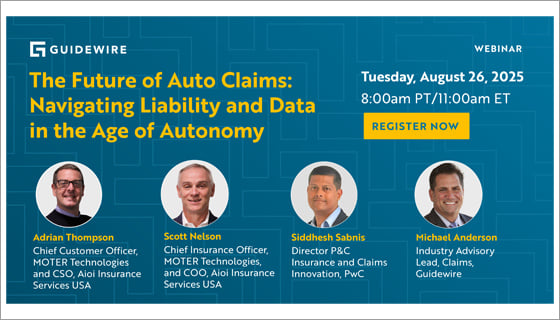
For more on this topic, be sure to join us on August 26, 2025 at 8 AM PT/11 AM ET for our webinar “The Future of Auto Claims: Navigating Liability and Data in the Age of Autonomy”, featuring experts from MOTER Technologies, PwC, and Guidewire. Register here.