Having explored the significant impact that autonomous vehicles (AVs) are bringing to the insurance industry in Part One, Part Two shifts focus from understanding the drivers of AV claims transformation to focusing on execution - what insurers should do to build AV-ready capabilities across their teams, technology, and operations.
Building a Future Ready Claims Organization
Handling autonomous vehicle claims will likely demand new talent, tools, and modern core systems to accommodate complex workflows efficiently. A modernized claims organization may:
- Ingest real-time vehicle data via connected vehicle platforms (OEMs, driver apps, etc.)
- Use AI for triage, distinguishing system (hardware, software, sensor, etc.) failure from human error so that the claim can be serviced by the at fault entity
- Create a virtual reality of the accident scene including vehicle(s) behavior, speed, direction, etc., using data to verify statements, facts of loss, and assist in liability
- Hire and/or access engineering expertise to analyze AV behavior and determine fault
- Automate complex investigations through advanced modeling and claims analytics
Some insurers are already prototyping claims interfaces embedded within vehicles, enabling first notice of loss (FNOL) directly from the dashboard. Others are deploying predictive tools to flag likely subrogation cases while tech firms are creating virtual accident scenes based on vehicle data. These innovations hint at a scalable model but require legal clarity, regulatory standards, interoperability, and OEM collaboration.
Challenges in Data Science and Model Development
A significant barrier to a truly intelligent AV claims function is the data science challenge. Building reliable predictive models for liability and severity hinges on large volumes of quality data, yet most AV crashes today are rare, proprietary, and fragmented. In many cases, insurers should negotiate with OEMs or rely on third-party brokers to access vehicle logs.
Even when data is available, questions of ownership and consent limit how it can be used for training AI models. This means that future-ready claims organizations should not only build data science capabilities but also forge legal and technical pathways to gain rights to the data and create models that can function effectively despite limited, inconsistent, or delayed inputs.
Reinsurance and Risk Transfer: New Structures for New Exposures
AVs introduce a paradox: fewer crashes, but higher-severity claims when system failures occur. This demands a fundamental shift in reinsurance:
- Traditional treaties based on event frequency or severity may no longer suffice.
- Future structures may focus on component-level risk pools (e.g., software bugs, sensor performance, or firmware defects).
- Subrogation will likely become a more common path to recovery, affecting reserve strategy and claim cycle length.
The industry should consider treaty redesigns that align more closely with technical failure modes, not just bodily injury severity or vehicle damage.
What Insurers Should Consider Now
To stay ahead, recommendations for insurers focus on these key areas:
Core Claim System Capabilities: Cloud-native core claims systems are vital to insurers' agility and speed in handling claims by enabling real-time data ingestion, automated workflows, and supporting integration with third-party platforms - all of which is essential for resolving complex, data-driven AV claims.
Liability Frameworks: Adapt to data driven fault determination and build product litigation expertise.
Data Strategy: Invest in ingesting, storing, and analyzing vehicle data, with emphasis on timeliness, privacy, access rights, and normalization.
Cloud + AI Enabled Workflows: Automate claims triage and investigation using AI and crash reconstruction tools. Establish seamless customer workflows with OEM’s when they are found liable (in whole or in part) for the loss.
OEM and/or Data Aggregator Integration: Establish structured, scalable data-sharing partnerships with OEMs.
Underwriting Innovation: Evaluate developing hybrid products that combine auto and product liability coverage.
Collaborative Infrastructure: Join or build industry platforms for shared standards, workflows, legal templates, and analytics.
Engineering the Future of AV Claims
As autonomous vehicles become more prevalent, insurers should fundamentally reimagine the claims process. Traditional models built around driver fault and manual investigation are no longer sufficient in an era where liability often rests with software, sensors, or system design. Claims in the AV landscape will be fewer in number but significantly more complex, requiring deep technical analysis, real-time data access, and collaboration across a broader ecosystem that includes OEMs, tech providers, and legal stakeholders.
To be ready, insurers should invest now in building claims infrastructure tailored to autonomy. That means deploying cloud-native systems capable of ingesting and analyzing vehicle data at FNOL, establishing structured data-sharing partnerships with OEMs or aggregators, and hiring interdisciplinary talent including engineers, data scientists, and product liability experts. It also requires developing AI tools for automated triage and crash reconstruction, and redesigning reinsurance and subrogation strategies around technical failure modes. The AV transition isn’t just a technological shift; it can be a challenge that redefines the claims value chain.
How Guidewire and PwC Can Help
Guidewire provides the digital core claims platform that insurers will need to integrate AV data, automate workflows, and scale new liability models. Its cloud-native architecture and rich ecosystem of APIs position insurers to adapt quickly as OEM connectivity and data-sharing standards evolve. PwC, a Guidewire PartnerConnect Global Strategic partner, complements this with strategic advisory services, helping insurers rethink their claims operating model, evaluate liability frameworks, and build the data governance and analytics capabilities essential for AV readiness. Together, Guidewire and PwC offer insurers the tools and guidance to modernize claims not just to keep pace with autonomy, but to lead it.
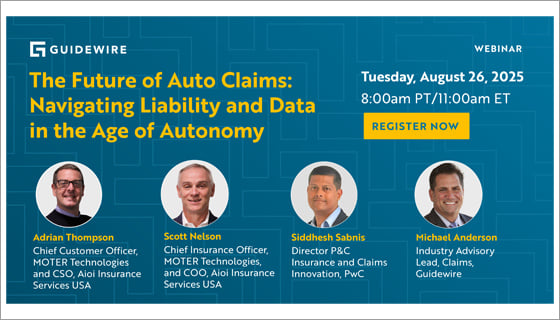
For more on this topic, be sure to join us on August 26, 2025 at 8 AM PT/11 AM ET for our webinar “The Future of Auto Claims: Navigating Liability and Data in the Age of Autonomy”, featuring experts from MOTER Technologies, PwC, and Guidewire. Register now.